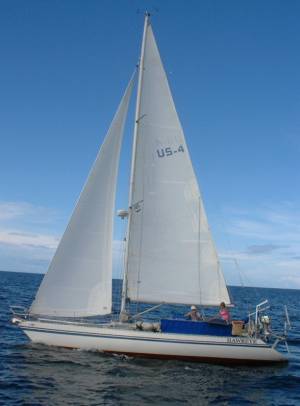
Sunday, May 31, 2009

HAWKEYE HAPPENINGS, May, 2009

HAWKEYE HAPPENINGS, May, 2009

The last newsletter was from Savusavu, Fiji, so we’ll continue from there.

Cyclone season starts on Nov 1 in the South Pacific, and we planned to avoid the season by sailing north to Majuro, Republic of Marshall Islands. We were anxious to get underway as it was now well past that date. We had been waiting to hear if the troubled country of Fiji, which was taken over by a military coup (the fourth coup in twenty years) in Dec, 06, would change its’ ruling once again and allow boats to stay for a longer period of time. The word was that they were going to extend the time to 18 months but that never happened and we did not want to have to leave during the height of the cyclone season. It was time to go. Linda worked on provisioning for an extended trip and John worked on those the never-ending boat projects. HAWKEYE and crew prepared for going to sea with the strong possibility of rough weather as we would be not only be going through the South Pacific Convergence Zone (SPCZ), just south of the equator, but also the Inter Tropical Convergence Zone (ITCZ) on the north side of the equator. Both these zones are known for unsettled squally weather and are the result of NE and SE trade winds meeting in the vicinity of the equator.

We left the mooring in Savusavu at 1:15 a.m. on November 12. Good weather was predicted and it was a beautiful sunrise and morning. A welcome current gave us a boost through the Somosomo Straits that afternoon as we sailed north to clear the island of Viti Levu. We were doing great until we ran into head winds and things got really black when we looked behind us back towards the Somosomo Straits; we were being “chased“ by sinister black skies containing great lightning flashes, squalls and heavy rain. Our concern was to get past all of the reefs and islands of Fiji and into open ocean waters. We finally accomplished this at 6 a.m. the following morning.

The log book reads lumpy, rolling seas, reefed down as the boat was going way too fast for comfort. This was followed by beautiful sailing under a full moon, just about perfect! After 109 hours and 596 miles, we entered the lagoon at Funafuti, Tuvalu (formerly the Ellice Islands), anchored and got some much needed rest. The next morning we anchored off the wharf; it took us two days to finally get checked in. HAWKEYE was the only cruising boat in the whole of Tuvalu. We spent 11 days in Funafuti with a lot of time spent at the weather station looking at weather and getting to know the people there. This is NOT a tourist center!! There are no souvenirs to be had. We couldn’t even buy a sizable flag (it is maritime etiquette to fly the flag of the country being visited from beneath the starboard spreader).

At the one and only hotel we had a meal and watched the employees dance to their native music. The food was pretty basic and was the first time we had pandanas fruit. This is very nutritious but doesn’t have much flavor. We managed to get some bananas after asking around at several homes (no charge). One home was a bakery where the lady made bread by hand all morning long. They use coconut oil to grease the pans so the bread has a different flavor. Their monetary system is the Australian $; being pre-warned, we had obtained some before leaving Fiji. Food was expensive as everything is shipped in. A cabbage was $10AU (about $7.50 US). We were pretty well stocked up but got a few fresh things.

Most people in Funafuti get around by motor scooter and we rented one from the hotel for $10 AU per 24 hr period. We were able to cover the atoll from one end to the other in about 45 minutes of sightseeing but rented it for 2 days anyway. There are very few automobiles on the atoll. The US built an airstrip there during WWII and the airstrip is used for walking, riding scooters and bikes, playing games, and meeting to gossip. The airport is a very tiny building and the fire department sounds a siren whenever a plane is approaching or leaving, which isn’t very often-maybe once a week. This tiny country covers less than 10 square miles of land but has a population of approximately 15,000 people of which about ½ live in Funafuti.

If you were not a believer in the effects of global warming, a trip to Tuvalu would make you a believer. We saw pictures in the weather station, which is right by the airstrip, of the times when they haveshigh tides and strong winds. The water covered the air strip and up to the door of the weather station! It is predicted that in 50 years, Tuvalu will no longer be above water. Upon finishing their education, children are encouraged to go to other countries to settle as all will have to leave soon. We enjoyed our stay but were anxious to get underway as we still had a lot of ocean to cover to get us safely to the north of the cyclone season area.

November 26 we departed Funafuti with the intention of going straight to Majuro, Republic of Marshall Islands (RMI). We decided to employ a professional weather service as we were approaching the convergence zones and there could be nasty weather ahead with very little warning. The weather was pretty good and we were making good time on a great course for Majuro, allowing for the westerly-setting Equatorial Current. On Dec 1 at 6:30 a.m. we received an email from Commander, our weather service, recommending we divert to Tarawa, Kiribati (pronounced Kiribass) to avoid heavy convection i.e., bad weather, en-route to Majuro (friends heading to Majuro from Vanuatu decided to press on and ran into the nasty weather predicted, causing damage to their rig). We were quite happy to divert since we had heard good reports of Tarawa from other cruisers and it was a good excuse to visit. We now had to slow way down, to avoid arriving at the pass into Tarawa at night. This proved to be quite difficult since we had a west-setting current of 2 knots pushing us along. So, reefed way down, we sailed south, tracked south-west, and arrived at Tarawa, Kiribati on Dec 2 mid-day. We had sailed 815 miles from Tuvalu to Kiribati.

We spent a week in Tarawa seeing as much of the area as we could. The WW II tour was very interesting and very sad. During the 3-day U.S. invasion of the Japanese-held island of Tarawa in 1942, 8,000 died. Of the 5,000 Japanese defenders, only 17 survived. To this day, the beaches and reefs are home to countless rusting relics of planes and ships – including live shells, bombs and bullets.

On a lighter note, the following paragraph taken from “THE SEX LIVES OF CANNIBALS, Adrift in the Equatorial Pacific”, by J. Maarten Troost, gives a great description of Kiribati:
“To picture Kiribati, imagine that the continental U.S. were to conveniently disappear leaving only Baltimore and a vast swath of very Blue Ocean in its place. Now chop up Baltimore into thirty-three pieces, place a neighborhood where Maine used to be, another where California once was, and so on until you have thirty-three pieces of Baltimore dispersed in such a way so as to ensure that 32/33 of Baltimorians will never attend an Orioles game again. Now take away electricity, runny water, toilets, television, restaurants, buildings, and airplanes (except for two very old prop planes, tended by people who have no word for “maintenance”). Replace with thatch. Flatten all land into a uniform two feet above sea level. Toy with islands by melting polar ice caps. Add palm trees. Sprinkle with Hepatitis A, B, and C. Stir in Dengue fever and intestinal parasites. Take away doctors. Isolate and bake at a constant temperature of 100 degrees Fahrenheit. The result is the Republic of Kiribati.”

As is the case with most travel books, this description, although amusing, was highly colored and exaggerated. We greatly enjoyed our visit to Tarawa.

We departed Tarawa on December 9. Although we had cleared out of Kiribati, we had received permission to visit the tiny atoll of Butaritari on our way north. We arrived December 10 and were warmly welcomed by the local villagers. We explored the island on rented scooters with our friends from the yacht RUBICON, Matt and Elizabeth. Later, we were invited to a celebration feast welcoming the local athletes back home from the annual games in Tarawa. It was a wonderful experience to get the flavor of the outer atoll life which is quite different for Tarawa.

With a good weather window forecast, we finally set sail for Majuro on Dec 16. Once again, we went too fast and ended up hove-to in the lee of Arno Atoll for a few hours so as to arrive at the pass into Majuro lagoon in daylight. We arrived Dec 19, just in time for the Xmas parties. Our total sail from Savusavu to Majuro was approximately 1800 miles but a much harder trip than out 2800 across the South Pacific.

Although the Republic of Marshall Islands (RMI) is now an independent country, it maintains close ties with the USA. It was a pleasant surprise to find the green-back was the local currency; even better, Majuro boasts a US style supermarket, with many US brands available. RMI even has its own US zip-code (96960) with sometimes fast, cheap priority mail courtesy of the USPS.

Thanks to the local ex-pats, the Mieco Beach Yacht Club, and local businesses, Majuro is actually host to a series of yacht races during the winter and spring months! Generous prizes are offered by local businesses, with first prize being a 55 gallon drum of diesel fuel. Interestingly, you don’t have to win the race to get a prize. Every boat finishing the race gets to draw a ticket out of a hat; that way, even the last boat to finish has the chance of winning the first prize. With over twenty visiting yachts, the first race was held on the first Sunday of December, with 10 boats on the starting line. The fleet included everything from a local Marshallese outrigger sailing canoe, a trimaran and monohulls up to 60’. It sure makes handicapping a challenge!

Unfortunately, Hawkeye was still bashing her way north to Majuro and so missed the first race in December. Subsequent races included steering our triple-reefed “houses” around anchored ships and buoys in squally conditions with winds up to 30 knots. After taking 5th place in the second race, due to a broken halyard block at the masthead, which prevented us from raising or lowering our mainsail, HAWKEYE won the next 3 races in a row. As is so often the case, we were “rewarded” by John being elected vice-commodore of the yacht club and director of racing for next season. Sometimes, it pays to keep a low profile!

April 14th is the anniversary of the liberation of Aur Atoll from the Japanese back in 1945. The mayor of Aur had previously invited visiting yachts in Majuro to join the islanders for a big celebration, and eight yachts departed Majuro lagoon for the overnight trip north to Aur. As usual, it is strongly recommended to arrive at the pass into the lagoon during daylight hours, preferable with the sun fairly high and behind you. That way, it is much easier to see the coral reefs each side of the narrow pass. With some trepidation, recalling that our friends Matt & Judy aboard the Cabo Rico 38 ELSEWHERE lost their boat on this same reef last summer, we entered the lagoon without any problem.

The party was a great success, with the visiting yachties treated as honored guests. Games included - what else? - baseball, and lots of races for the boys and girls. The cruisers lost the tug-of-war to the local team; never underestimate the pulling power of the local ladies! The feast provided by the ladies was delicious and more than ample. Some of the cruising ladies, including Linda, worked with the many children and women teaching them beading. We went through lots of beads and they didn’t want to quit. We were rewarded with several of their home made crafts made from pandanas. A fun and bonding experience we will not soon forget. On a sad note, it was noticed that there are lots of scars on those little arms and legs from staph infections and several people were observed with vision problems due to conjunctivitis not treated. The people have access to medical supplies but don’t seem to want to be treated per the local World Teach teachers. Head lice are prevalent but as there is no dirt just coral and they spend a lot of time swimming in the lagoon, they are quite clean. The coral dust causes lung problems so it is common to hear coughing.

After a few days enjoying the hospitality of the people of Aur, boats started returning to Majuro or on to other countries. HAWKEYE and the Hylas 49 CREOLA headed north to the next atoll in the island chain, Maloelap. Again, this atoll was the scene of ferocious fighting between the entrenched Japanese and the US forces. At one island anchorage, Ollot, we anchored near the submerged wrecks of two Japanese ships and discovered the remains of several Japanese Zero fighter planes. Unfortunately, the weather changed late in the day, with the wind switching to the south-west instead of the normal NE direction of the trade winds. As we swung on our anchor, the chain wrapped around a coral head (“bommie”) and around the stern of one of the ships! Luckily, our friends from CREOLA and Linda still had their tanks on after a scuba dive and were able to clear our chain. We promptly raised anchor and beat a hasty retreat to a safer anchorage.

We are now back in Majuro, enjoying the Wi-Fi internet access from the boat, the restaurants and shopping ashore. We are planning our annual trip to the USA to visit family and friends and will be gone July through mid September. Please send your news; if you would prefer not to receive our newsletter, just let us know. You won’t hurt our feelings!

Best wishes to you all for a great summer.

John & Linda.

Friday, October 31, 2008

HAWKEYE HAPPENINGS, October, 2008

HAWKEYE HAPPENINGS, October, 2008
Ni sa bula,
Our trips to the states all always looked forward to. We love visiting with family and friends. This year was no exception. The thing that was different this year was that John and his grandson, Frankie, went to Texas with Linda to visit Trish and her family. We all had a great time, especially Frankie!

After much packing, unpacking and packing again with a break in between for Linda to have a day of kayaking with friends Georgie and Paula, we were off to return to HAWKEYE which was on a cyclone mooring in Savusavu, Figi. The three different airlines we flew, all had different requirements as far as number of bags and weight per bag. In the long run, it was well worth the time spent on the packing as we only had to pay an additional $20 USD on excess weight.

When we arrived at the airport in Nadi, Fiji, we were concerned with getting through customs. There was a very long line and John went up to an official stating we had a connecting flight. The official asked what we had to declare and he said, “Nuts (we always bring back an assortment of nuts for baking and technically nuts and seeds are not allowed.).” The agent said to get our things and come over to him. He then proceeded to usher us passed everyone, including the other agents and we were out the door! We will remember this ploy in the future. Just so you know, we did have a connecting flight but it wasn’t for a couple of hours…..

We had received word from other cruisers that the airport in Savusavu was closed as it was unsafe. Unsafe? They didn’t tell us that when we flew out three months before!! It seems the runway is too low and too short; mmmmmmm.

Our domestic flight was to Labasa pronounced Lambasa. The Fijians are great in putting in the sound of “m” in words but not the letter. From the airport, we were not looking forward to the bus into town and then a 3 hour bus ride over gravel roads through the mountains in an open
bus (tarps roll down the sides if it rains) to Savusavu. Upon arriving at the airport in Labasa, Linda discovered a small air conditioned bus and inquired as to where it was going-Savusavu. Yes!! Can we get a ride? How much per person? And, I’ll be right back with one other person and our luggage. PLEASE DON’T LEAVE! After getting John and all our luggage, we got on our air conditioned bus for the small fee of $20 per person. The ride only took 2 hours and they gave us a nice lunch which turned out to be our dinner also. The bus had been hired by the Cousteau Resort to pick up a family of 4 and there was plenty of room for us. They delivered us to the marina and we were most thankful.

The bad news was when we arrived back on board. We had paid for the boat to be looked after. HAWKEYE was supposed to be opened and aired out on a regular basis including removing any
mildew down below. This was not done, however, and we spent the rest of the day and the next 2 days cleaning up the interior, removing all mildew and making her sparkling clean again. After unpacking, John started on the long list of repairs and addition of new things to be installed. This list is never fully completed as there is ALWAYS more to be added than removed no matter how much we try! John installed new steering chain and cable, a new autopilot, a new GPS, a propane sniffer and many repairs.

After 3 weeks, we felt we were ready to head out to the anchorages. Our first anchorage was near the beautiful, exclusive, Jean Michele Cousteau Resort where they fly guests in on seaplanes each day. They have some villas as well as bures where the rich and famous stay. We love this anchorage as “split rock” is a football field away with awesome snorkeling. In the prevailing winds, it is a very protected anchorage. We stayed there a few days working on small jobs like cleaning the bottom of the boat and relaxing, listening to the drums at sundown from the resort, watching the full moon rise, and just being happy to be where we are.

We were anxious to get back up to Viani Bay and snorkel the Rainbow Reef we had enjoyed just before we headed to the states. Once again, we met Jack Fisher, the local guide and made arrangements to have him take us out snorkeling. Linda had her new underwater housing to try out and managed to take quite a few pictures.

A few days later, John decided to take a hike over to another bay. John did not have a good day. He missed the trail and got lost in the bush. He had to go through thick brush to get to a hill so that he could see where he needed to go. He ended up pulling a muscle in his leg and had quite a strenuous time getting back.


Linda, on the other hand, went out to the reef with Jack Fisher and a couple from Holland and did two tank dives. Both dives were exceptional and it was a good day for her. That afternoon, Linda went with the couple from Holland to Jack’s village for a visit. It was Friday afternoon and the village was having a fund raiser. The children from the village were going to travel by boat to Taviuni to compete in sports events and they were playing card games with donated prizes and selling kava to raise the money. By the time we got there, the card games were over but the kava drinking was far from being over. We had a few bowls of kava and visited with the families before heading back to the boats before dark as we had to go around the reef to get there.

Those of you who haven’t experienced kava drinking, here is an abbreviated version. Yaqona, a root, is pounded into a powder and then put in a rag. This is washed through water in a 3 legged large bowl and looks like dirty dishwater. This is then called kava. Kava is served with some ceremony. A half of a coconut is used as a “cup”. You are presented with a cup (everyone drinks from the same cup) of usually ½ tide for the palanges. You clap once, take the cup in both hands between thumbs and index fingers and drink it down in one swift go. You then hand back the cup and clap 3 times. After you have had the initial cup of kava, you can refuse, but it is considered poor etiquette to refuse the first cup. It tastes very “root” and leaves a sort of scum on your teeth and can make your lips numb. This is all done sitting in a circle on a mat on the ground. You must sit with your legs bent at the knees and crossed. The bottom of your feet must never be toward the center. Shoulders and knees must be covered at all times. It gets mighty uncomfortable sitting on the ground with your legs crossed for any length of time and even harder to get up!

The next day we went ashore to visit with Jack and his wife, Sophie and their daughter. We were given pumpkins (squash) from their garden and we gave them fishing line, soap and yeast. It is hard to keep “even” on this trading thing. It always seems that these people that have very little always end up giving us more.


That afternoon we sailed with GAIA, the Dutch boat to another secluded bay where we stayed two nights. They snorkeled the reef close to the anchorage but Linda had an ear infection and had been taking amoxicillin and ear drops since the onset a few days previous.


Our next passage was to Rabi Island (sounds like Rambi) about 20 miles away. We anchored in Albert Bay inside
the reef and went ashore to present our sevusevu-the yaqona to the women on the beach. We were welcomed and given permission to anchor in the bay. There are 12 people living in the small village at Albert Bay. They originally came from Tuvalu, a country that is sinking into the Pacific due to global warming. These people live in very primitive huts made from sticks with mats on the sand floor made of palm fronds. We were invited into one of the homes sort of igloo shaped . They speak both Fijian and English. We were given 2 papaya and a freshly caught fish. We asked what they needed and they said batteries for their torches (flashlights). By looking around, we could see that they could use just about anything. Linda was given a hand made necklace that they sell and she agreed to pay for it the next day.

We went through our “give away” supply the next morning and were able to get together some things we knew they could use. We gave them batteries, paper, pencils, tea, sugar, hair ties, fishing line, lures, Band-Aids, aspirin and an inflatable globe which caused quite a bit of
discussion as to where we are from and our path followed to arrive in Fiji.

The eldest woman told us she was 57 and her husband was 62. They were very surprised to hear that Linda is 67 and John 75. They told us we looked much younger; and , compared to them, we do look much younger. These people lead a very hard life just trying to feed themselves on a daily basis. They subsist on mostly fish which the men spend most of the day or
night trying to get. They do grow fruit and some vegetables. They probably never see a doctor as their village is so remote; however, our friends Dan & Brenda Paull were headed that way. Dan is a retired cardiologist from Seattle.

They wanted us to take pictures of them and so we did. We made some copies for them and they were very pleased to receive them. There was one young couple that was particularly handsome with two little girls. They dressed in their finest for the picture. There is some hope that these people will make quite a bit of money when
they decide to sell their yaqona. It is now three years old and should bring top Fijian dollar in a few years. We wish them well.

In the afternoon, while we were relaxing reading, there was a sharp rap on the hull. John went up and there was one of the men handing up a nice lobster which we had for dinner that night. Our next trip in we gave them a pumpkin and explained that they could plant the seeds in their garden. We also gave them some ginger which they could plant. They gave us egg plant and
drinking coconuts as a parting gift. At this point, we felt we were close to being “even” in the gift department but we are richer by far with the memories of this little village and its’ people.

At 6 a.m., sunup, we headed from Rabi Island north and west around the most northern tip of Vanua Levu and very large reef. Once around the top of the reef, we were in calm waters after a boisterous 15 mile run. We had dragged a meat line from Rabi without a bite but once around the reef and timed perfectly, we snagged a 12 lb mahi mahi. By the time we got it cleaned and in the refer, it was time to take down the sails before entering the pass to the approach to Also Island. Jim Bandy is the morning “Rag Net” net control. He monitors boats on passage from Samoa in the east to Australia in the west and from the Marshalls Islands in the north to New Zealand in the south. He gives extensive weather reports and assists cruisers in any way he can. We first met Jim and his wife Kioko on their Passport 42 ALSO II, in the Sea of Cortez back in 2000. They crossed the Pacific in 2001 and got this far. They met the villagers and helped them by actually purchasing and putting in a new motor in the village boat. Jim & Kioko were “given” an island as a “vinaka (thank you)” . Kioko said this is where she wants to spend the rest of her life and so they have developed ALSO ISLAND. Jim has a boat building-repair business in which he has locals working for him. He teaches them how to build boats and repair motors. They also have a few guest houses on the property, an extensive garden, hiking trails, a coconut oil “factory”, a small general store , are collecting and selling honey, and hold open house each afternoon at 4 p.m. when tea is served and lively conversation abounds.

We had arranged with Jim back in April to come to Also Island and use his facilities while we
varnished the interior of HAWKEYE. It turned out to be a great place to do this. We moved everything from the main saloon to the forepeak and aft cabin, removed all pieces of wood we could which we took to shore and Linda sanded and varnished there while John worked on the sanding and varnishing of all parts that could not be removed. We stayed in one of their rooms and had our meals there also. It worked out very well.
Over a period of five days, we completed the job and put
HAWKEYE back together. She now looks much better down below. That old saying is true, “Cruising is working on your boat in exotic places.”

On Sunday, Linda and Kioko went to the village to attend church. We wore the proper attire of a dress covering the shoulders and knees and went by boat. Upon arriving to the bay where the village is, we discovered that the tide was going out and we had to walk in mud ankle deep to
get to shore. Once there, we were able to wash out feet in fresh water and put on our sandals. Kioko is known by all in the village and we visited several families in their homes. We sat on mats on the floor with children running around shouting “Palanges!”. They all wanted their pictures taken and Linda obliged. When shown the picture in the camera, they would all point at each other and giggle.

The Methodist church service was in Fijian, but the a capella singing was so beautiful it didn’t matter what language. Beautiful floral arrangements supplied by the villagers adorned the pulpit. After the service, those we had not visited, stood outside the church and introduced themselves with handshakes and beautiful smiles.

We were invited for lunch to one of the homes and sat on a large mat on the floor. A bowl is passed to wash your hands and a towel. It was a typical Fijian meal of taro, bele in coconut milk (like a strong spinach), cabbage and juice made from “lemons” a very tart orange centered fruit. The only utensil was a large spoon as they eat mostly with their fingers. No home has screens so flies are everywhere and makes it difficult to eat. All in all, it was a wonderful experience with these oh so friendly people.

While waiting for the trades to settle down and so we are now working our way along the north coast of Vanua Levu another boat showed up. BARBARA ANN, with a family of 4, are from Miami, FL. We ended up buddy boating with them for the next few weeks. After leaving Also Island, we had a wonderful sail in and out of the reefs enjoying incredible scenery. One night we anchored off Vorovoro Island which is where the Adventure Vacation facility of “Tribe Wanted” is located. It seems to be a successful operation at this time with plans to expand their “village” where people come to live the working life of a Fijian for a few weeks. After a tour of the village, we raised our anchor and sailed 5 miles and anchored off a lumber mill. We were able to get a truck to Labasa with our buddy boat, BARBARA ANN, and had lunch and did some much needed grocery shopping after being away from any stores for over a month. We decided to stay the night at that anchorage and BARBARA ANN sailed another 8 miles to the next anchorage where we joined them the next morning. We visited the beautiful resort of Palmlea Farms and had lunch and dinner there while visiting with the owners. They are raising some special goats for the meat and also have 4 guest bures. The next day we sailed down to yet another anchorage where we visited another resort on the island of Nukubati. Yet another upscale resort.

The reinforced trades held. We moved on to other anchorages bobbing and weaving through the reefs which at times were quite scary as there is a problem with our Max Sea on both computers. The system keeps crashing and John has spent hours working on it with help from other cruisers over the ham radio. As of yet, he has not found the problem and so traveling is quite stressful as there are so many reefs. We hope to get into Savusavu safely over the next few days and see if we can get the problem fixed. This will greatly affect our traveling further at this time.

A tip for cruisers or to be cruisers. We don’t have a freezer. Linda’s daughter made a real find for us this summer. She found a brand new food saver at a garage sale for $5 and picked it up for us. We can now vacuum pack meat and it will keep in the bottom of our 1.5 cubic foot refer for 3 weeks or more. Now all our spare parts are vacuum packaged, including our spare GPS, which makes them waterproof.

We have loved our stay in Fiji and would love to stay longer but our visa runs out during cyclone season so we must leave soon and head north to the Marshall Islands which are north of the equator and out of the cyclone area. Another adventure awaits!

Vinaka vaca levu, John & Linda

Saturday, May 31, 2008

HAWKEYE HAPPENINGS, May, 2008

HAWKEYE HAPPENINGS, May 2008
The cyclone season in Tonga turned out to be quite benign of which we are thankful. The one scare that we had, was good practice for us. We headed into Nieafu and got on our cyclone mooring and prepared the boat. This means taking off all canvas (dodger, biminy, etc) sails, safety gear, jerry jugs and everything else that we can. Once HAWKEYE was put to bed and her mooring lines secured with anti-chafe gear, we headed to shore with our friends, Matt and Judy. They had gone through the same exercises preparing their boat, ELSEWHERE. After securing our dinghies in a protected spot, we headed to a motel for the rest of the afternoon and night. That evening we watched the wind and rain and played cards and visited. The cyclone never came and the next day, things looked better. DAMION had moved on out to sea and blew itself out. We chalked the experience up to practice in preparedness and discussed what else we should have done. We, on HAWKEYE, had made up a “to do” cyclone preparedness list the year before and we referred to it which was a big help.
Christmas was spent out at beautiful Tapana anchorage with turkey and most of the trimmings. Pumpkin pie was squash pie and there was no celery for the stuffing but we all enjoyed it anyway. Judy and Linda were able to score a very expensive turkey in town but it was worth it and we were able to get several meals from it. New Year’s Eve was spent in the same location and “early” as we are just across the International Date Line and welcomed in the New Year a whole day before you in the states.
In January, several of the yachts that had been in Tonga for over a year, received letters from the Head of Customs stating they must either import their boats and pay a tax of about 20% of their boat’s value or leave the country. This put us all in an uproar with lots of discussion as to what to do. We had been in Tonga over a year but did not receive the letter. Apparently the day they did the survey of boats in the area, we were hauled out painting HAWKEYE’S bottom and doing some other maintenance needed when out of the water. The Customs People neglected to see us on the hard. They did know we were around, however, as our new rigging came in and we spent quite a bit of time trying to get it out of customs. We ended up having to pay duty, which they promised us we would get back before we left Tonga. Yeah, sure! We wrote a letter of complaint to the Head of Customs in the capitol and received a letter back assuring us we would receive the duty paid back when we left Tonga.
A meeting was called in Nieafu of all boats that had received the letter and anyone else interested in the subject. There was a good turnout and the Head of Customs was there. He is a Kiwi that Tonga hired to take over the problems in customs and clean it up. He talked a great length and understood our problem and was eager to work with us. By the end of the day, a document was presented to each boat owner stating that their boat was exempt under the old rules and that these boats could stay in Tonga forever if the owners chose. It was a great relief to all of us.
John spent a week up and down the mast installing the new rigging, roller furling, and then replaced the lifelines. We were finally ready to leave Tonga but it was still cyclone season so we enjoyed the time waiting for a safe weather window to head to Fiji. Linda was able to do some diving of the major dive sites in the area with one of the local dive businesses whenever he had a space on his dive boat. One day was spent with Ben and Lisa the owners of Aquarium Café/Internet and Kart Safaris. We covered several miles of beach, bush, and forest in the Karts. If you ever get to Nieafu, it is a must to do.
The Vava’u area is quite small and word travels quickly. Everyone knew that we were waiting to head to Fiji and one day a small boat used to go between villages came up and a palangi (white person) told us that he and his wife had brought a young Fijian fellow to Tonga with them and that he needed to get back to Fiji as his visa was running out. They told us Tom was an orphan and had lived in a detention center for five years, as there was no facility for orphan boys in Fiji, only orphan girls. They said he was a nice boy and that he would really like the experience of sailing to Fiji and they were hard pressed to come up with the airfare to send him back. We agreed under some trepidation. Tom is 16, had never been to sea, knew nothing about sailing and we had not met him. As the days wore on, we wanted to back out but couldn’t figure a way to get out of it gracefully.
The day before we were to leave, we finally met Tom. There were a number of people there to “witness” the event. We had little time to talk to Tom separately. There was another Fijian man there that had crewed on a boat from Fiji and he did most of the talking. I think he was doing an assessment of us out for Tom. We ended up checking out that day with Tom on our crew list. He seemed like a nice fellow to us and there were so many people concerned about the situation, mostly on Tom’s side that we decided it would be an experience and hopefully a good one. He had a good attitude and a winning smile.
While going through the checking out process, we were told we had 12 hours to leave the country. Our plan had been to check out because our visas were expiring within the next few days and so was Tom’s, spending a day or two getting the boat ready and then head out. It would give us time to get to know Tom and for him to get comfortable on HAWKEYE. Customs finally gave us 24 hours to leave the country. If we had any difficulties, we were to see them and they would decide if they would allow us to stay longer. Our next step was to get back that duty we had paid thinking this might be our excuse, as they would probably give us a voucher, check, or some obscure reason to not give the money back. We went to the Treasury Office under much trepidation. Customs had assured us that Treasury had all the necessary papers. Yeah, sure… The two palangis walk into the Treasury and they immediately said “John Kelly?” John said, “Yes.” The lady walked over to a drawer and handed us a stack of bills. We looked at each other and couldn’t believe it! We were now committed to leave in less than 24 hours.
We had an appointment to get duty free fuel at 3 p.m. and Tom and his friend, Joe, wanted to see the boat so we took them along to the fuel dock with us. The truck was there ready to fill the tanks and asked us for our duty free paper. What duty free paper??? No one told us we needed a special paper….. John sat with the boat, Joe, Tom and the fuel guy in the hot sun and Linda headed off to our favorite Customs Office and explained the situation. She was told that the paper needed to be requested at the time of checking out and to just go pay the duty and leave. Excuse me, but what will it take to get the duty free form? Linda was not leaving without it. Well, there is a new form and an old form and you are the first boat to leave under this new ruling and we don’t know what to do. Give me the two forms and I will fill them both out and then you can use whichever form you choose but we need to get our fuel now and they won’t give it to us unless we have the form. After much staring out to sea by the Customs Agent and Linda sitting looking at him waiting for the forms, the forms were copied and she filled them out. Finally the forms were signed, stamped and examined by others but, after 45 minutes, she had that necessary form in her hand. The Customs agent had told her earlier, “How do I know if the fuel is going to your boat?” “Well, come on down and see them put it in the boat.” It was now close to their quitting time and he finally gave his blessing and Linda went running down the dock with the form. By the time she got there, the guy had already filled the tanks and gerry cans and was about to pull away except Linda had the money to pay the bill. We had turned in all our Tongan money except for the exact amount to pay for the fuel and to have a nice dinner that night. What a fiasco but it turned out o.k. We think that Customs just wanted us out of there and hoped we would never return. HAWKEYE had been the “first boat” under the new rules in everything we did and we were sure tired of hearing it, as were they in trying to figure out what to do.
That evening we had quite a few laughs with our friends Steve and Tess over dinner. We had become good friends over the last 17 months. They run the “Crow’s Nest” restaurant in Nieafu and we ate there quite a bit and bought their wonderful breads, cinnamon rolls and bagels. Tess, who is Indian, gave Linda some cooking classes and Steve taught her how to make Bagels. We had had several meals and get togethers with them over our time in Tonga and we will miss them. We also had a sad goodbye with Larry and Sheri who have the Ark Gallery and Orion Charters in Tapana. Linda would snorkel with Sheri each day and we became good friends.
The next morning Tom was their bright and early. We set out an hour before our deadline of 11 a.m. We were told we could be fined $10,000 p’angas ($5,000 USD) if we were caught in Tonga after our deadline. On the way out, while still within the reef, we decided to keep going instead of going to an anchorage and taking a chance of being caught and fined. John got the wind vane rigged, John and Tom got the dinghy up on deck and we headed out the pass, next stop, Fiji.
We had light winds and calm seas. Tom did great until that evening when he became seasick. Linda gave him a Sturgeron tablet and that seemed to do the trick. Thank goodness. Tom was a delight. He was eager to help in any way but would ask for direction, which was great. We tried to show him the workings of the boat, navigation, safety and as much as he could absorb. Tom was very polite and a joy to be around. His smile was infectious. He LOVED the Ipods and we had to keep one on the charger at all times. He was a little unsure as he saw Tonga fade in the distance and only water and kept saying, “When will we see land again?” He seemed to relax and enjoy the trip but was excited when we saw the first of the islands of Fiji. He talked of his family. His mom had left his father 8 years ago with the two youngest children and he didn’t know where she was. He and two younger sisters lived with the father until he was killed and then the girls went to an orphan facility for girls and he went to the detention facility. He is very close to his sisters and was really looking forward to seeing them again. At 16, he couldn’t stay at the detention facility any longer and it was then that he met Stefan and Heather and they invited him to experience Tonga. He had worked making furniture in Suva and that was where he was headed upon returning to Fiji.
Our 425-mile crossing from Tonga to Fiji was quite pleasant with gentle winds and calm seas until the third day. We could see the island where we were going in the distance and were to be arriving the next morning. We had managed to dodge squalls until then. That afternoon, we had one come up on us that was a large cell. We shortened sail and for about an hour, John took the helm and we surfed down waves under 30-35 knots of wind spotting 3 waterspouts (one was a double). Thank goodness none touched down to the water and were not that close to us. Later, that same day, we had another squall but with no rain. We had to head off in the wrong direction for a while until it finally settled down and then we ran out of wind. We reached the dreaded, very large reef at the Savusavu point an hour before dawn. There was supposed to be a light that could be seen for miles. The light was very faint and we decided to head back out to sea for an hour until daybreak. At first light, we headed around the reef and into Savusavu and picked up a mooring. On the way in, we saw a ferry leaving. It was the ferry Tom was supposed to catch for Suva. He was very disappointed to have missed it as we had heard there was only one ferry a week.
After Quarantine, Customs and Immigration, and Agriculture all came out to the boat and checked us in (all very friendly), the guy from Agriculture told us there was another ferry going that evening and took Tom down to the ferry office to get his ticket. Before he left that evening, we went to shore and had a wonderful curry meal and said our goodbyes to Tom. John also made up a certificate for him and Linda got his e-mail address and sent him pictures of the trip. Having Tom aboard for the crossing turned out to be a wonderful experience for all of us. Would we do it again? Probably not; we were lucky and don’t want to push our luck!
We will be returning to the states on May 22 in time to see granddaughters graduate from high school and to spend some quality time with family and friends. Our return to Fiji is scheduled for August 14.
In the meantime, we are exploring the different anchorages along the southeast coast of Vanua Levu. Right now we are in the company of two other boats. A few days ago, we visited a small village and presented savusavu (kava) and asked for permission to walk up the creek to the hot springs. We had an enjoyable hike through the rainforest and a nice sit in the warm pools and the creek when it got too hot. We met people in the village (all with the last name of Pickering) and were invited back. While walking back to through the village, we met a fellow walking up the gravel road who had been to a funeral in another village. Linda’s camera had quit working after a snorkel earlier in the day and she missed a great photo opportunity as the fellow had two taro roots in one hand a cow leg over his shoulder (including fur and hoof). He told us that gifts of food are given to those people who attend the funeral and feast in honor of the person who died. He was bringing it home for his mother to cook.
Yesterday was spent on another boat swapping software, information on anchorages, and waypoints and tracks of where each boat had been. The reefs are many and treacherous in Fiji and we all try to help each other out. There are always new things to share in the cruising world.
Linda & John
P.S. We got up to Viani Bay and met some of the Fisher family. Jack Fisher took us out to the famour Rainbow Reef for snorkeling and on an inland hike to a small settlement. We look forward to our return to Fiji so that we can dive the White Wall, The Purple Wall and The Zoo. Our time in Fiji is limited by the government, which is now run by the military since last year’s coup. There is so much to see and do here and so little time! We may end up sailing to the country of Fortuna, which is a two-day trip over, and two days back just to be able to stay in Fiji longer.