We had been nervous and apprehensive about the trip since we decided to go in January and hadn’t said much about our decision to friends and relatives as well as other cruisers as we have seen and heard of many other cruisers that changed their plans, for one reason or another, after telling everyone that they were going to do something like this. We didn’t inform our families of our plans until we were well into getting ready to go. Several times during the three months of “getting ready” we changed our minds as things broke and were difficult to fix. Some of the major things we found out about when we hauled the boat in Salinas, Ecuador was blisters on the bottom which after much discussion with professionals decided to go with it “as is”. The next major hurtle was the propeller problem. When we hauled the boat, we found severe corrosion on the propeller. After weeks of trying to find someone going to the states to take it back for us so that it could be sent off the be repaired, we bit the bullet and paid to have it sent DHL to PYI in Seattle, WA. We were lucky to find someone coming down to visit other cruisers that were willing to bring it back for us.
Hundreds of projects were on our “To Do” list and gradually that list was brought down to minor things that could be done underway or at anchor in the Galapagos. After two months “on the hard” in the boatyard we were able to launch HAWKEYE, provision, and headed to the Galapagos.
We had a good breeze leaving Salinas, Ecuador and sailed well until the second night out on the 600-mile plus trip. John was on watch and had two fishing boats come within ¼ mile of HAWKEYE in light winds. He turned on the engine so we could motor away from them and that is when we heard the clunking noise for the first time. He turned the motor off after we had gotten a safe distance from the fishing boats and we the next day, when it was calm, he went over to check out the propeller and shaft to see if he could see anything wrong. There was a plastic bag wrapped around the propeller, which he was able to unwind and take off. We thought our problem was solved; but the next time we started the engine and put a load on it, we had the same clunking noise. Lucky for us we were able to sail the whole way to Isla Cristabol, Galapagos and were able to motor slowly to get into the bay and anchor without the clunking noise. John checked the propeller and shaft and all zincs upon anchoring; everything looked good. He next checked over the engine, shaft, and everything inside the boat. He finally found a broken motor mount that we were able to get fixed and John reinstalled. We then took HAWKEYE out for a spin and still had the clunking at high rpm under load. After having another cruiser that was a mechanic in his “former life” and the mechanic from the Port Captain’s office look at it, the consensus was to go with it and have the propeller rebalanced at first opportunity. John had also been in touch with the PYI via e-mail on the problem.
The decision was made to sail to Isla Isabela, Galapagos where we did some sightseeing, worked on chafing gear and got ready for the “puddle jump”. April 14, 2006 at 9 a.m. local time, we left Isla Isabela, Galapagos, Ecuador heading for the South Pacific with a tentative destination of the Gambiers, Tuomotos, French Polynesia.
We had a nice breeze and a good weather prediction when we left and that breeze held up until the middle of the night when the wind quit and we decided to motor for a few hours as the batteries needed to be charged anyway. After a couple of hours motoring, the motor reduced speed and stopped. John changed the fuel filter and we motored for a few hours more and it happened again. John looked at the new fuel filter and it was o.k. At that time it was early morning and a breeze had come up so we sailed. After checking with a mechanic friend, Rick, on SHE WOLF via the SSB net, we put reverse pressure with a tire inflator on the hose from the fuel tank to the filter. Rick said that biobore, a chemical we put into the diesel fuel to kill algie, kills the algie, but then sticks together and makes clumps which may have caused the clog. We were able to sail after this exercise.
Night two, two days after the full moon, there was an incredible moonrise and the moonlight on the water was beautiful. We sailed well all night under clear skies and perfect conditions.
Day three and we are still sailing. Our 9 a.m. 24 hour run was 133 miles. When John listened to the net, he heard that SAFIRE had lost a lower shroud yesterday and another one today. They are still about 600 miles from the Marquesas and not enough fuel to motor the rest of the way. Those closest to them have offered to divert to their location and give them fuel. This may take several days as there are no boats close by them. Theresa and Kevin are experienced sailors having sailed from England and around Cape Horn. Ran the engine from 7:30 p.m. until 8:00 p.m. to charge the batteries. Some squalls around but have managed to miss them so far. Had a few sprinkles this afternoon but no winds with it. Getting into the grove but John still not getting enough sleep. We both had trouble sleeping today as the seas were lumpy and the sails would slat. Sailed wing and wing most of the day. Did a jibe mid afternoon and put in one reef just before nightfall.
Day 4 we moved right along doing 130 miles in 24 hours. Winds manageable in the 15 knot range with some squalls at night but no high winds.
Day 5 was mostly wind in the 20-25 knot range with confused seas of about 6-8 feet. We triple reefed the main and jib and were still flying along. Not a comfortable day at sea. Had trouble with the engine quitting after motoring for 45 minutes. John bled the lines and managed to get it going again but quit again. This was our fastest day so far at 163 uncomfortable miles.
This proved to be an ongoing problem with John trying different things and managing to keep it going enough to charge our batteries. It does not give us confidence in going through reefs, however. Day 6 at 9 a.m. we had gone another 147 miles in the previous 24 hours in uncomfortable seas. Day 7 at 9 a.m. we had gone 149 miles. The windvane lines show signs of chafe and we end for ended some of the lines. Also, made leather covers for the blocks to make it quieter. There are lots of moans, groans, clinks and clanks going on all the time. Still under triple reefed main and jib. Seas down a little this day and not as uncomfortable as the day before. Got the towing generator in the water successfully and will see how it does getting more amps in.
The towing generator turned out to bring in enough amps to keep us from having to run the engine on a daily basis to charge the batteries. We now run the engine every third day for about one hour. It sure made a big difference.
Our engine problem persisted and John would do a number of tests and finally surmised that there is sludge in the fuel tank that clogs the intake to the engine, thus the engine is starved of fuel and quits. After talking to a number of people via radio and e-mail, he devised another fuel tank to feed the engine. Using a jerry jug of fuel, he installed lines to the engine bypassing the main fuel tank. This took several hours working under very rolly conditions but he succeeded and we once again had a reliable engine. He debated back and forth about going to the Gambiers. If we needed some work done, it could not be done in the Gambiers. Finally the decision was made when we got word that 2 cyclones were heading to the Gambiers. We then deviated to the Marquesas. One boat got to the Gambiers just before the cyclone hit and another, Valella, backtracked to a safe distance until it went by. Another boat, Stinella, headed for the Marquesas also. Each day the seas settled down more and it was easier to be on the boat. Still a lot of movement where you can’t set anything down on a counter top and expect it to be there for over a second. The best place I found to work was on the floor. I made Calabasas soup and bread while sitting on the floor as well as preparing chicken enchaladas. Washing dishes is hard as you have to use a foot pump, which then only gives you one foot for trying to balance yourself. I find myself hopping around a lot. Cooking is a challenge and I am glad I had prepared a lot of things ahead of time.
We have had some beautiful weather with sunny skies and very little squalls. None of the squalls so far have packed a lot of wind. We are thankful for that and that there has been very little rain. If we do have some rain, it is usually at night. Other boats have had squalls at night accompanied with wind. Our daily runs average in the 140 mile area and we are most frequently reefed down at least 2 reefs in the main.
John does a check for chafe on a daily basis and there has been chafe on the jib, and screws loosen on the vang. He has had to repair the towing generator and the windvane lines. The jib tends to rub on the turnbuckles of the lifeline at the bow and has caused holes in the bottom of the sail. We sewed a piece of leather on the bottom of the sail and now it chafes above the leather.
We are now in a new moon phase. John has the moon on his 9 p.m. to midnight watch and last night I had it for about the first hour of my watch. Oh, we had a 3 green flash sunset one night and a 2 green flash another night. Also, caught a dorado and had 3 good meals from it. Fresh food just about gone and have started to eat canned fruits and veggies. Still some fresh meat in shrink-wrap left. Doing well in the food department.
Lots of good wishes from people sending e-mails. Have had numerous problems sending update through email and John has had difficulty in connecting. FIGMENT had 3 broken shrouds and has jerry rigged and going slow. TRUNDLE lost his prop and is sailing but needs help getting into anchor. One boat has engine problems.
In the early morning of May 4, we passed a boat, Morning Light. On May 5, we passed ALK and Wind Castle. More moonlight at night now, until 3 a.m. No more squalls and beautiful skies. Had less wind night of May 5 but managed to keep going. Passed another boat on morning of May 6.
There seems to be a growing interest in cruisers coming to Ecuador. HAWKEYE has been based in Ecuador for two years now and we have really enjoyed being here. The two places to choose from are Bahia de Caraquez and La Libertad/Salinas. Bahia is further north, within half a degree of the Equator and the anchorage is in the estuary of the Rio Chone. A pilot is required to enter the estuary. Cruisers and Puerto Amistad both monitor VHF channel 69.
Tripp and Maye Martin developed Puerto Amistad. They were cruising on their Island Packet 30 WALKABOUT two years ago and fell in love with Bahia upon arrival. Prior to their arrival, Gary Swenson, a retired jet-car jockey, had already placed a few moorings in the estuary. Gary had sold his cruising boat QUARTER SPLASH, and was building a beautiful home outside the beach town of Canoa about 10 miles north of Bahia where he now resides with his wife, Merci, a Bahia native.
Tripp and Maye spent a year plus going through all the paperwork to have Puerto Amistad built. Their gorgeous facility caters to both cruisers and locals. They can deliver water, gasoline and diesel to the moored boats, as well as pick up and deliver laundry. The current price for a mooring is $150 per month. They have hot showers and Maye’s open-air restaurant serves wonderful meals and drinks at a reasonable price (large Pilsner beers for $1.) Built over the bay on an old Navy dock, this is not only a hangout for the cruisers’; it is a place to mix with the locals. It is the new “hot-spot” in town and a favorite of visitors from Quito and Guayaquil. The facilities can be used during the daytime to work on sewing projects and classes and has an extensive book exchange. There is no haul out facility at the present time.
Bahia is a small town but has a number of high rises that are mostly vacant. It is a beach resort for people from Quito to visit during their holidays and can get a little crowded; the rest of the year it is a quiet town. There are no large grocery stores but most things can be purchased at one tienda or another and there is a wonderful Mercado for fresh fruits, veggies, and meats as well as freshly ground peanut butter and beautiful bouquets of flowers for $1 - and wonderful white pineapples 3 for $1! Transportation around town is by “eco-taxi”, or tricicleta, which is a bicycle with 2 front tires and a bench in between them with a little awning over for shade and room under the seat for groceries. A ride from the Mercado to the dinghy dock is 50 cents. Bahia has an extensive Malecon and a beautiful beach where people have found incredible shells, ancient pottery shards and petrified shark and whale teeth.
Bahia, well south of the hurricane belt, is a great place to leave your boat and travel inland. There is an air-conditioned bus to Quito 7-8 hrs for about $9 and to Guyaquil for $7 that takes 5 hrs.
La Libertad is further south along the coast. Puerto Lucia Yacht Club has a wonderful facility with a 50-ton travel lift, electricity and water at each site. The dry storage and work area is located on a breakwater with a beautiful view of the ocean and is well ventilated with a cooling sea breeze most days. George Stewart, a former Canadian cruiser, runs the yard and his men can do as much or as little work for you as you want. He is knowledgeable and very helpful. His prices approach those in the states, but his work is of the highest quality. There are bathrooms close by, and a cruiser “get together” area with tables and chairs under a canopy. For a 40 foot boat, the first month costs about $400 whether on the hard or Med-tied in the harbor. Haul out and back in adds about $350 to this charge. The monthly rate is reduced 10% each month until the 7th month. The yard has room for 20 boats. The Yacht Club has a nice restaurant and wonderful pool as well as tennis courts in a guarded beautiful compound. If you don’t want to stay on your boat while working on it, they have facilities and there are also inexpensive hotels near by. El Paseo shopping center is within walking distance and has boutiques, a supermarket, movie theaters and a food court.
Guayaquil is a 2- 2-½ hr bus ride away where there is an international airport and is the gateway to several inland travel sites. Travel is inexpensive by frequent bus service that goes just about everywhere and hotels are quite reasonable.
Which marina to visit? They are so completely different and depending on what your preferences are, they both offer unique experiences. Why not visit them both?
Teri from s/v ISHI and I did an inland trip for 2 weeks while John and Gary were doing those jobs on the boat that require tearing the boat completely apart for a long period time and requires the first mate to either sit at one spot or leave the boat. We decided we would try to limit our expenses to $25 per day and we were pleasantly surprised that it was not difficult to do this. We stayed in adequate hostels and had wonderful meals. The scenery was spectacular, the people friendly. Ecuador offers beautiful beaches, colonial towns, mountain vistas, waterfalls, primary rainforest jungles, pre Inca ruins and many other things. Come and enjoy this wonderful country and its’ people. We are now getting ready to head back to the South Pacific and new adventures. Linda Keigher & John Kelly, S/V HAWKEYE, Sirena 38
I had set up the dates for this trip when I was in the USA visiting my brother, Terry, and sister-in-law, Gerry, as well as old friends Tom & Eileen Riordan. As the date approached, John found he was not able to get everything done that he needed to do in the States (he had sold his property in the Seattle area and was trying to do a 1031 exchange for a duplex in the San Francisco Bay area). Sailing friends, Nancy and Herman of the sailing vessel SEA TERN decided to join me on the trip. The following are excerpts from my log of that five-week trip:
Sat., Nov 5. Piura. We walked around the Plaza de Armas and visited a Cathedral on the square then managed to get a colectivo (this is like a VW bus with several seats in it) to visit the craft market in the village of Catacaos. This village is noted for their basket weaving, filigree jewelry, wooden utensils, pottery, and carved gourds. Our ride back to Piura was in a 12-passenger van with 18 people in it!
While walking back to our hotel at 3 p.m. and while in a busy intersection, a guy ran up, punched Nancy in the arm (as a distraction) and stole Herm’s change purse off his belt. The guy almost got Herm’s camera, which was on his belt right next to the change purse. The guy went running down the street and was gone before anyone could give chase. Nancy ended up with a large bruise on her arm but amount of the theft was less than $10.
Sun., Nov 6. Chiclayo. We visited the National Museum of Sipan, where artifacts of the Mocha Indigenous People of Sipan who lived in the area about 2000 years ago (well before the Inca) were exhibited. These people used gold, copper, and silver to make their elaborate clothing and armor. They used spondylus shell from Ecuador and thread of cotton to make great neck coverings. Their graves were filled with these riches, which were uncovered after some grave robbers had broken into a minor grave in the area but fortunately did not get into the richest one.
“Motos” are a popular means of transportation in the cities of Peru. These are motorcycles that have 2 wheels in the back with a seat between them. They have a roof and side curtains. Some are quite elaborately decorated. This mode of transport is cheaper than a taxi for short distances.
The next spot we visited was the village along the coast where they still use the reed boats for fishing. We examined the boats and watched the fisherman go out and come in to the beach in them. Nowadays, they use styrofoam with the reeds around the outside but they still don’t look very sturdy to go out on the ocean. Tues., Nov 8. Trujillo. The ride on Impresa Buscama was most comfortable. This was our first time on such a comfortable bus. On the bottom floor, the seats are only 3 across. They are like recliner chairs with leg rests and huge picture windows for viewing. Terrible videos are played as on most long distance buses south of the US/Mexican border but the scenery is great and we try to block out the noise of the full volume speakers.
We visited Museo Cassinelli and saw an amazing collection of 3000 pieces of pottery dating back to 1200 B.C. and up to the Moches period. This was quite an experience. We arrived and a man opened the door. He had great difficulty getting the ticket book in the right position for us to sign the tickets. We guessed he was almost blind. After we did the tickets to his satisfaction, he hunted for the door lock to let us into the basement museum. Even though he did not speak English, and our Spanish is “poquito”, he managed to explain quite a few of the pottery pieces to us. He made us quite nervous handling these 2000-year-old pottery pieces and several times knocked pieces off their little stands but his luck held and none of them broke (there were a few stands where things were evidently “missing” but we didn’t want to know!).
Wed., Nov 9. Our tour of the day was to the Temple of the Moon. These ruins turned out to be over 6 levels high. New buildings built over ruins of other generations with painted walls of many different patterns. The Moche god “Decapitator” was depicted in various moods from anger to happiness. Grave robbers had destroyed part of the temple and removed unknown riches and ceramics from the 1600’s. Later, at the museo in Trujillo, we saw some that had been recovered. Thurs., Nov 10. The Banco Central museum was the first item on our list for today. It was a wonderful museum as are most Banco Central Museos in Peru. There were 3 tables with double legs in each corner and a marble bathtub in the garden. We explored colonial buildings and museums and ate wonderful turkey sandwiches and ice cream. We visited the ruins of Chan Chan where the Spaniards had taken all the riches from the graves and destroyed most of the ruins. Chan Chan was a large development and the grounds cover several miles. There are many intricate designs in the adobe walls.
Fri., Nov 11. After an all night bus ride, we arrived in the beautiful town of Huraz at the elevation of 3200 meters (just under 10,000 feet). We immediately noticed the elevation upon alighting from the bus. Getting up the stairs to our rooms at our hostel was a chore that had us gasping for breath. After a short nap and shower, it was now 7:30 a.m.; we had some breakfast and a chat with Edward of Edward’s Inn. He is an interesting fellow who has learned English from the tourists that visit his inn. He is also an accomplished mountain climber and has scaled every major mountain in South America. He leads climbs in season. Edward set us up for a tour of the area. We visited Laguna Cullicocha, which is a glacial lake of brilliant blue water. The view of the mountain peaks covered with snow is unforgettable. We went out on the lake in a rowboat and hiked around a little, still trying to get used to the “thin air”. Several stops were made along the way back to Huraz; one of which was Yungay. In 1970, there was an earthquake that caused an avalanche, which buried Yungay killing 18,000 people. The guide was a child at that time and his life, together with those of several other children from the village, was saved. The children were attending a circus away from the direct hit of the avalanche. As there were so many orphaned children who had lost all of their family, the government decided to allow these children to be adopted by people all over the world. Our guide had some family so he stayed in the area and was raised there. There is an impressive monument and a very large crypt housing several of the bodies.
Sat., Nov 12. We got a taxi to a viewpoint over the city of Huraz. I decided to climb to the highest point for a spectacular view of not only the valley, but also the snow capped mountains surrounding the valley. Nancy had on shoes with no traction and had a hard time going down the hill. I loved the hike but it was hard on both Nancy and Herm. I ended up on some steps overlooking a farmer’s fields with him watering his alfalfa. It was a beautiful view and felt good just sitting there. Nancy and Herman went a different way and Nancy fell and got all scratched up. It was not a good hike for her but she does darn well for 78 years old!
Sun., Nov 13. I decided to take another tour to Chavin ruins, which were totally different from the adobe ruins we had seen previously. This ruin was made of stone and was the home of about 200 priests. The courtyards were laid out using exact measurements, taking into account the sun, and solstices. The interesting thing was that an impressive stela is in the center of the buildings underground. It is obvious the stela was done first and then the building built around it. These priests slept underground in very small rooms with vents for fresh air. We were able to go into these halls and small rooms underground. Getting to Chavin required going through a tunnel in the mountain at an elevation of 4500 meters (14,800 feet). There are people living at this elevation! The guide told me that they live in stone huts with grass roofs that I had seen on the ride up but thought they were for grains or animals. He said that families averaging 8 people live in these huts. They eat only 2 meals a day. They cannot raise crops at this elevation but raise sheep and llamas, which they use for food and wool, which they sell or use to make items to sell. They have no doctors or schools in this area. They watch over their animals all day and return to their homes in the evening-a very hard life. Mon., Nov 14. Later in the day, Herm decided he would go back to the room and Nancy and I walked around the market. We got down to the Mercado and I felt a person right next to me. I turned to look at him and didn’t like the looks of him. Another guy was on the side of Nancy. I stopped and yelled for Nancy to stop. The guys stopped also. I backed up to a car and told Nancy to follow me. We walked into the street and into the boulevard in the middle. A woman came up to us and said “robbers”. I said, “si, robbers”. The two guys, both with a jacket over their shoulder covering their hand, took off and we walked back to our hotel feeling very lucky. I had just gone to the bank and had money in a back pocket but had my jacket tied around my waist hiding my pockets, which seems to work for me so far.
Tues., Nov. 15, Lima. We had a ceviche lunch that was delicious after being hounded as we got out of the cab by representatives of all the restaurants. When finished, they wanted to charge us way too much but I said no and we only paid the price on the menu. Had our first pisco sour (rum, egg white, and lime juice), the national drink of Peru.
We tried to get a moto to take us back to our hotel but they can’t go on some streets. I had waved to some policemen that went by in a car and they turned around and stopped. They asked where we were going and told us to get in. We were told we were not in a safe neighborhood and they took us to a museum. It was great fun talking to them and they were concerned about us. Nancy took a picture of Herm and me with the policemen. They were great guys and we had lots of laughs even though we didn’t speak the same language! The museum they took us to was great. We really enjoyed the tour and explanation of the pictures that the indigenous people painted for the Spanish after they had Catholicism shoved down their throats. They revolted in subtle ways like putting cuy (Peru delicacy of guinea pig) in a painting of the last supper.
That evening, as prearranged, Gerry, Terry, Eileen and Tom arrived at 11 p.m. in Lima. I felt they had missed so much all ready but more was to come!
We visited Museo de la Nacion, which is a huge museo on several floors. We had a guide that explained all the different indigenous peoples in chronological order. Each floor, from bottom up, was of a different era and a very interesting 3 hr tour. We then toured a San Francisco convent and church and catacombs filled with bones. Sat Nov 19. At an elevation of 3326 meters, Cuzco was the Inca capital and the hub of travel in Peru. Cuzco has a great Plaza de Armas and lots of colonial buildings. We took a tour, visiting several churches as well as some buildings built on top of Inca ruins and the ruins of Sacsayhuman, Qenko, Puca Pucara and Tambo Machay. On another day, Terry, Tom and I revisited Sacsayhuman again and spent about 3 hours viewing these awesome ruins. One of the rocks that they moved to build one of the walls weights over 300 tons. How did they do it???
Sun, Nov 20. The Sacred Valley Tour started with a visit to a large craft market at Pisca and then to various ruins
one of which was Ollanntaytambo. These ruins feature interlocking rocks that are virtually earthquake-proof. The site, a massive fortress, is one of the few places the Spanish lost a major battle during the conquest. The village was divided into blocks called canchas, each cancha with just one entrance leading into a courtyard. Individual houses were entered from this courtyard, not directly from the street. The huge, steep terraces guarding the Inca fortress are spectacular. Ollantaytambo is the fortress to which Manco Inca retreated after his defeat at Sacsayhuaman. In 1536 Hernando Pizarro led a force of 70 cavalry here in an attempt to capture the Inca. The steep terracing was highly defensible and Pizarro’s men found themselves continuously showered with arrows, spears, stones and boulders. They were unable to climb the terraces and were further hampered when the Inca, in a brilliant move, flooded the plain below the fortress through previously prepared channels. Manco Inca’s victory was short lived, however, as the Spanish attacked again with 4 times the forces and finally took over.
Tues, Nov 22. The Big Day. We met our guide at 6:15 a.m. at the town square in Aguas Callentes and bussed to Machu Piccu, the “Lost City of the Incas” found by Hiram Bingham in 1911. It remains a mystery as to its’ function but is the least damaged ruins in Peru. The two-hour tour was very informative and then we were free to explore on our own. Terry, Gerry, Eileen and I climbed Huayna Picchu from Machu Picchu. Terry and I went on to find a geocache, climbed to the Inca Drawbridge and then up the Inca Trail towards the gate of the Sun. Terry made it to the gate but I couldn’t keep up and started down as we were to get the last bus down the mountain at 2:30 p.m. I got lost and ended up way too far down, exhausted, but got to the bus at 2:30. Wed, Nov 23.The next adventure was to fly to Puerto Maldanoldo and then down the river by boat to a jungle resort where we stayed for 5 days in a secondary rainforest. The visit to the Monkey Island was disappointing for me as the monkeys were “planted” there and bananas are brought to the island daily and hung from the trees to feed them-a guarantee that the tourists will see monkeys on their trip to the jungle. Thurs. Nov 24. Wonderful chirping of birds awoke me at 5 a.m. after good night’s sleep. It is Thanksgiving in the US. Went by boat across river and 4K hike to Lake Sandoval. Canoed around lake and hiked back in the rain. Visited a viewing tower. Saw prehistoric looking birds called Hoytzin, and some red howler monkeys. We returned covered with mud and wet but it was a great hike. On a night walk, we were shown a female tarantula and a poisonous caterpillar. Fri. Nov 25. Today’s excursion was to a Research facility where we saw monkeys in the trees that had been at the reserve because they were sick or injured. They were now free to come and go and one came right up to one of the women and sat on her lap. It was raining and finally let up a little so we could see the animals in the cages that had been saved or were healing from injuries. There is a puma that was saved as an infant when the mother was killed. Unfortunately, it will never be placed in the wild as it is too used to humans. It ran and jumped on the fence where a guy was standing and would have jumped on his back if the fence weren’t there.
We saw lots of birds and other animals in cages and a couple of toucans that landed in the trees close by; quite different from ones I had seen before. There were also some different butterflies and spiders. When the rain let up a little, we hiked to a canopy bridge that was up 200 feet and about 300 feet long. We struggled across and back-not for those that are bothered by height. It dipped in the middle and, with the rain and wind, was a difficult crossing. There was a great view from the observation tower on the other side. From there we went to a farm where they were experimenting growing different crops and animals and teaching the people in the jungle to farm so that they wouldn’t kill the wild animals. Back at the lodge, we went on an early evening boat ride to try to see the caimans. The water was high due to all the rains but we managed to see a few. Edwin, one of the guys working at the lodge, caught a caiman about 4 yrs old and brought it on the boat so we could all see one up close and personal. Edwin had come to my cabina on our first night there to install a new light bulb and we sat and talked for a while. He really wanted to learn English and when we left, I ended up giving him an old translator that I had. He was very grateful. He wanted me to work more with him but we didn’t have the time. Tom did work with another fellow who was very appreciative and gave Tom a bracelet made with jungle seeds. It really meant a lot to Tom and he enjoyed working with the guy. I don’t think he has taken the bracelet off; I wouldn’t either; those are really special moments shared with someone of a totally different culture.
Tues, Nov 29. Lake Titicaca. We visited an old steamship, the YARAVI that was the first steamboat to navigate Lake Titicaca, the 138-mile-long highland lake that straddles the Peru-Bolivia border. The ship is under renovation to sail again on the lake. The steamer weighed 200 tons and was built in Scotland in 1862. That same year it was sailed from England to the southern Peruvian coast. There it was completely dismantled, and since the railroad to the lake was not completed, the pieces of the ship were portaged on mule back through some of the most rugged of all Andean country. At Puno, on the shore of the lake, it was reassembled by Indian laborers under the direction of a Scottish engineer who knew neither Spanish nor any of the Indian languages.
Terry and I went to Sullustani, a very interesting burial sight of great towers the tallest of which is 12 meters. The towers are either round or square and house the remains of Colla nobility who were buried in family groups complete with food and belongings for their journey into the next world. On the way there, we saw unusual homes with arches and ceramic bulls above the doors. It is believed that these bulls guard their homes and keep them safe. Wed, Nov 30. We did the Lake Titicaca tour in the morning visiting the floating islands and a school on one of the islands. These people lead a totally different life on these islands located on the highest navigable lake in the world. Here is an interesting tidbit I read in the traveler’s bible, the Lonely Planet book of Peru. “How Indians Adapt to Altitude”. At an attitude of 10,000, feet most people begin to suffer from lack of oxygen. The Andean Indian, who lives at altitudes up to 17,000 feet, has developed certain physical characteristics to get the most use of what oxygen exists at those heights. His lungs are bigger than normal, so that he inhales more air with each breath. In the walls of every person’s lungs, there are tiny sacs in which oxygen is transferred from the air to the blood. In the Indian’s lungs these sacs are permanently dilated to provide maximum surface for the oxygen transfer. The circulatory system is also modified, the Indian has about two quarts more blood than do lowlanders, and the red blood corpuscles, which carry the oxygen, are considerably bigger. Finally the heart itself, which pumps blood and oxygen throughout the body, is larger than normal by almost 20 per cent.”
Thurs, Dec 1. Arequipa. This is a beautiful colonial city with lots of museums, beautiful buildings, and good food. Fri, Dec 2. Left Arequipa with our guide for Chivay and the Colca Canyon. I took some drug N & H got in the morning for altitude sickness, that horrible headache that plagued most of us. Because we were going to 5052 meters (16,600 feet), our guide suggested we chew on coca leaves. I chewed the leaves and after 64 years of no drugs, immediately got high. This feeling lasted a couple of hours and was very scary. When my head finally cleared, I was able to enjoy the great scenery. We saw lots of vicunas and were told their wool sells for $1,000 per kilo! They can run at a speed of 40 kph. We stopped at a small town for coca tea where a medical team from the US arrived about the same time and started treating people that were lined up. We got to the pass at about noon and then started down to the Colca Canyon. People had made “Apacheta”, a Quechua word, at the top. It consists of a pile of rocks at least 3 rocks high (and lots higher), which symbolizes a connection to the sun. That evening pan flutes and folklorical dancers entertained us at the restaurant where we had dinner.
Sat, Dec 3. Up early to go to the place where the Condors hang out. They can live up to 75 years and have a 9-foot wingspan. They eat animals that have been dead about 10 days. We saw 2 flying at a distance and a young one closer to us. The beautiful view of river 1200 meters below and mountains at 3200 meters high was spectacular. We saw a boulder with Pre-Columbian carvings and a map of terraces. Back in Arequipa, we had dinner that night at a roof top restaurant. Ponchos were provided as well as pan flutes. Brides and grooms walked the Plaza de Armas below us. It is a tradition that they walk the different plazas for two hours between their wedding and reception.
Sun, Dec 4. Terry and I went river rafting and really enjoyed the mostly class 3 but some class 4 rapids with giant mountains all around. Great fun! We took the 10 p.m. bus to Nasca where we flew over the mysterious Nasca lines which are huge geometric designs drawn in the desert and visible only from the air. They were made by the simple expedient of removing the darker sun-baked stones from the surface of the desert and piling them up on either side of the lines, thus exposing the lighter colored soil below. Some designs are animals and figures as well as lines. We also toured the aqueducts made by early indigenous peoples so that they could have water in this desert country.
Mon, Dec 5. Terry, Gerry and I bused to the desert town of Paracas, which is on the coast and took a tour of National Reserve, which was along the sand dunes and beaches. We explored a large cave and saw boobies with babies, and red-footed cormorants. The SEA TERNS decided to head back to Bahia and Tom and Eileen wanted to go to Camana located further south on the coast.
Tues, Dec 6. Took the tour to Isla Batista where we saw lots of birds and sea lions and on the way to Peru’s “Galapagos” we were able to see the candelabra which is a giant figure etched into the coastal hills rather like the figures of the Nazca Lines. No one knows who made the ancient drawing or what it signifies. The amazing thing is how is stays there. All to soon, it was time to head to back to Lima where the group flew back to the U.S. I returned by bus (a mere 36 hour bus ride) to Bahia de Caraquez where John was waiting on HAWKEYE.
Some cruising friends, Ray and Bernie, had left Bahia and were touring Peru at the same time we were. We met them in the hotel in Puno. From there, they bused up to Cuzco. They chose the night bus not the tour bus that we had taken from Cuzco to Puno. About 1 a.m., the bus stopped to pick up a passenger and the guy that handles the luggage got off to put the man’s luggage under the bus. He was held a gunpoint and others joined him from the brush. They got the driver off the bus and then drove the bus to a deserted area and took all passengers off the bus by gunpoint and robbed them. Ray had the presence to hide most of his money and their passports in the cushions and overhead on the bus before they were made to get off. The robbers got their wedding rings and about $40 in cash. Ray kept telling them that his wife, Bernie, didn’t speak any Spanish so they left her alone other than taking her ring. They were very lucky and were still very shaken up when telling their story upon return. They were the only foreigners on the bus and the Peruvian people on the bus were very sorry this happened to Bernie and Ray. They were told that they must have had a far greater loss than the Peruvians as Peruvians don’t have much to lose anyway!
Sorry to have rattled on and hope I didn’t bore you too much. I know that these emails get long, so if you don’t find them of interest, please let us know, (it won’t hurt our feelings.) and we will delete you from our mailings. Linda [JSK1] Buacama
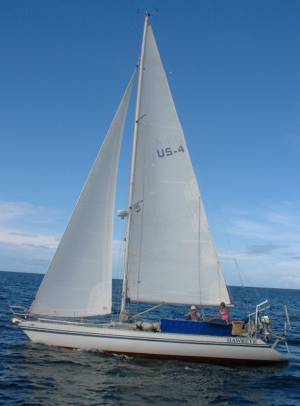
HAWKEYE is a Sirena 38 built in Finland in 1984. She is 38 feet long and has a 10 foot 3 inch beam. Her fractional-rig mast is 55 feet tall and she carries a lot of sail (682 sq. ft.). She weighs 12,000 lb and about 15,000 fully loaded and is powered with an 18 hp 2 cylinder Volvo diesel engine. Steering is provided by an auto pilot and wind steering vane; live-aboard equipment includes refrigeration, water maker, 4 solar panels, VHF and HF radios with email access via the winlink system, radar, a ten foot Aquapro dinghy with 15 hp Yamaha engine.
John was born in England October 18, 1933. He married and moved to Canada in 1960 after completing his education as an engineer. He & his family moved to Seattle in 1964.
John owned a 26 foot Thunderbird sloop
and, later, a Cal 40. He raced the latter in the 1986 Victoria to Maui race, placing 3rd overall.
In 1993, after selling his interest in the Cal 40, he bought the Sirena 38 HAWKEYE. He departed from California for Mexico in 1994 and has been cruising since then.
Linda was born in Joliet, IL, July 9, 1941. In 1968 she moved to California with her family and divorced in 1979. In 1986, she purchased a Explorer 45 sailboat named HINANO and lived on it until she 1995 when she sold it and went cruising as crew on Jim and Diana Jessie's Lapworth 48, NALU IV.
Christmas, 1995, Jim Jessie introduced Linda to John in Zihuatenajo, Mexico. They saw each other over the next two years in different anchorages and towns in Mexico.
In May, 1997 they found themselves crew on a Freya 39, IOLANTHE, sailing to the South Pacific. They returned to Mexico and have been together on HAWKEYE since that time.
In 2000, after cruising Mexico for several years, we decided to head further south to Central America. Over the next few years we explored Guatemala, El Salvador, Honduras, Nicaragua, Costa Rica and Panama.
We crewed with folks taking their boats through the Panama Canal and decided we would rather go down towards South America instead of going to the Caribbean. Two wonderful years of exploring Ecuador, Colombia and Peru and we were ready to head across to the Galapagos and then the Pacific Islands where we have been exploring ever since.
 someone coming down to visit other cruisers that were willing to bring it back for us.
 having sailed from England and around Cape Horn. Ran the engine from 7:30 p.m. until 8:00 p.m. to charge the batteries. Some squalls around but have managed to miss them so far. Had a few sprinkles this afternoon but no winds with it. Getting into the grove but John still not getting enough sleep. We both had trouble sleeping today as the seas were lumpy and the sails would slat. Sailed wing and wing most of the day. Did a jibe mid afternoon and put in one reef just before nightfall.