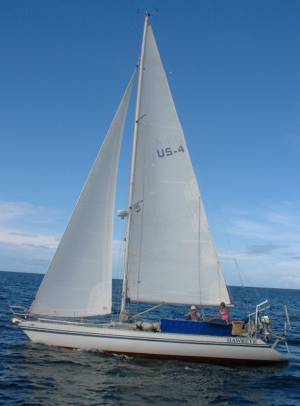
Tuesday, October 31, 2006

HAWKEYE HAPPENINGS, October, 2006

HAWKEYE HAPPENINGS, OCTOBER, 2006

From the lagoon and that wonderful pass at Fakarava Atoll, in the Tuomotu Archipelago, we sailed about 180 miles to Tahiti. It was a good passage and as we arrived at the pass through the reef to Papeete, the wind decided to escalate to 30 knots. It was a nerve-wracking sail through the pass and through the narrow passage with reefs on both sides. Some of the marks into the anchorage were missing so it got quite confusing in the heavy wind, a hefty current, around the airport runway and into the lagoon where we finally were able to get a slip at the dock as we had a long list of things that needed to be done. After a week at the dock at $42 U.S. a night and a few of the projects completed, we headed for the anchorage before we had gone completely broke! Things were slow to happen and we ended up in Papeete for 3 weeks. Papeete is not one of our favorite cities in the world. There is lots of traffic and smog from vehicles and the prices are outrageous. We did, however, manage to spend one day with our friend, Joe Scirica. We had sailed with Joe on his boat, MUSIC, to the Galapagos and then on to Panama the year before. He had single handed his boat from Costa Rica to Tahiti and was shipping his boat back to Mexico and flying back to the U.S. We so enjoyed visiting with him and will miss him as we cruise.

From Papeete, we sailed to Moorea. It is only about a 20-mile trip but we ended up in a squall with high winds. At one point, our wind meter decided to quit when we were blasted with 30-knot winds. During the squall, the rain was so heavy we were not able to see mountainous Moorea even though we were less than 1 mile away. We sailed towards Cook’s Bay and Opunohu Bay using radar and GPS and finally, as we approached the bay, the squall cleared and we could see the pass through the coral reef and the protected bay beyond. It was great to get inside the reef with calm seas and get the anchor down in 10 feet of clear water and relax.

One morning we took a long dinghy ride down to the place where the stingrays hang out and got in the water with them. They come right up and eat out of your hand and rub up against you and there are a LOT of them. Small black tipped reef sharks swam around looking for scraps of food also. Later, we heard of an Aussie swimmer who died from a stingray on the Great Barrier Reef. A sobering thought.

Another day we hiked up to the Belvedere lookout with people from two other boats where we could see down into both Cooks and Opunohu Bays and the surrounding reef. A great hike through the forest to a marae and then up to the viewpoint. Our reward was a wonderful sorbet treat on the way back down.

One evening we went with cruisers from two other boats to the Bali Hai Hotel to watch the dancers perform and sing. It was then time to think about heading to the island of Raiatea where we had scheduled a date to haul the boat as our repaired max prop was being sent back from the states after being balanced and bearings replaced. This seemed to be the problem of the clanking since leaving Ecuador. Seems they had slipped up and not done all the repairs. They will never understand the grief it caused us! But, they did pay for all the shipping charges and repairs they should have done in the beginning…

Anyway, it was an overnight trip to Raiatea and we arrived through the pass into a beautiful anchorage where we stayed waiting out high winds. We took a trip up a river through jungle to beautiful botanical gardens and had a tour and explanation of plants of the area. It was an enjoyable float back down the river and a fun afternoon visiting with cruisers on two other boats. One day we hitchhiked (the accepted way to travel around these islands) to Marae Tapataputea, the most important religious and historical site in French Polynesia.

The fun was over for a while as we headed to Raiatea Carenage Marina and the haulout. We were out of the water four days. John took off the fixed blade propeller and installed the Max Prop. He did a bunch of other maintenance and repairs and Linda cleaned and waxed the hull. Once again, we had a guy come out to work on our refrigeration. It had worked 1-½ weeks since Papeete where we had a guy work on it for 3 weeks. Once back in the water, we headed for the town of Uturoa. The propeller now vibrates at 2600 rpm instead of 2400 rpm (no vibration at all with the fixed blade prop, but that one slows us down too much when we are sailing. I guess we will live with the vibration). We tied to the dock and spent 3 days there. The hike up the hill to the microwave tower was worth the climb as the view was spectacular. We could see the island of Tahaa across the channel and the reef that surrounds both islands and could see Bora Bora 20 miles away. During this time, we had high winds again that blew us on to the dock so we had every fender we have out trying to protect our newly cleaned and polished hull. We also ran numerous lines to different cleats on the dock. It was a rough stay and we were glad to get away early one morning when the winds were down a bit. People from 3 other boats helped us to get away. We had done the same for boats leaving before us.

The sail over to Tahaa was very enjoyable and we relaxed on a mooring in a beautiful, quiet bay and a night of uninterrupted sleep. The next day we were ready to sail the 30 miles to Bora Bora. Again, we had an enjoyable sail and arrived to the pass into the lagoon of Bora Bora just as a freighter was coming out and another coming in. We all three passed at the pinch of the reef. John steered HAWKEYE as close to the side as was safe in order to get out of the way of the two big guys.

We managed to find a mooring right in front of the famous restaurant, Bloody Marys and had a wonderful dinner to celebrate Linda’s birthday, which was back in July. It was worth the wait! We shared our table with another cruising couple on the boat SONGSTER. They are from England and he also worked in the airplane business so there was a lot in common to talk about.

Jackie told us about her having terrible pain in her leg towards the end of their crossing from the Galapagos to Marquesas. Upon arrival in the Marquesas, she was airlifted to Papeete and had surgery to remove a non-malignant tumor. Brian had to sail the boat from the Marquesas to Papeete single-handed and of course was extremely worried about her the whole time. It was quite an experience but they have overcome it and are heading further west.

We had two great snorkels while in Bora Bora with lots of pretty fish and one enormous Moray Eel. The water was crystal clear and warm. The boat looked like it is sitting in air, the water is so clear!

As soon as we had a good weather window, we headed further west. We were going to stop at Palmerston Island in the Cooks but the weather was not good in that direction and so we headed directly to Suvarov (or Suwarrow), which is also one of the northern Cook Islands. This motu is spectacular!! It is a national park about 475 miles from any other land and there is only the caretaker and his family living on this island. John and Veronica and their 4 boys are a joy to meet and visit with. They love having the cruisers visit and want to keep Suvarov unspoiled. Last year they had 114 boats visit and this year 92 have been here. It is just about the end of the season and they will be returning to Rarotonga in October for the hurricane season and will return next April if the government will allow them to. There is a wonderful book written in the 60’s named “An Island to Oneself” by Tom Neale, a New Zealander, who lived on the island alone and wrote of his experiences here. It was a very special read for us.

In the week and ½ we have been here, we have had 3 potlucks and gone on several excursions. We walked the reef from Anchorage Island, which is the main island where John & Veronica live, to Whale Island. It was a wonderful walk mostly in ankle deep water looking at all the beautiful coral and fish-keeping an eye out for sharks and eels that tend to come up and bite on the ankle if given a chance. Another day John took a group of us over to Gull Island to visit the Frigate, Terns, Boobie and Tropic Bird nesting places. We got to see eggs, young, and adult birds of all species. The Tropic Bird is noted for its’ long tail and there were also red footed boobies which we hadn’t seen before. We did a great snorkel on the reef by the birds.

Yesterday, we went with two other boats in our dinghys to Lewin reef inside the lagoon and did a wall snorkel. The most exciting thing seen on this snorkel was the eagle rays. It was so neat to check them out as they fluttered through the water like large butterflies. At one point, a small one went straight up and out of the water and landed with a large splash just a few feet from us. The spotted eagle ray has five barbs at the base of their tail and one does not want to monkey with them!

Today we did another drift snorkel with some other boaters near the pass and went along with the current holding on to the dinghy. At one point, we got behind the reef and had just gotten back into the water to look at some Napoleon fish and a huge shark with big teeth came cruising by. He was 10 to 12 feet in length and quite large around and had spots on him. Not anything like any of the other sharks we were used to seeing on or snorkels here. He was about 20 feet away and we quickly jumped into the dinghy and headed back to the anchorage. Upon checking in our shark book, we concluded it was a Tiger Shark which are quite vicious and have been known to eat just about anything including humans. Well, that was today’s excitement!

We are now waiting for a weather window to head to Pago Pago, American Samoa where we hope to have parts shipped in. HAWKEYE has not seen U.S. waters since 1994 and her crew is looking forward to getting some American products. Our progress has been slow and we are definitely at the end of the pack but we hope to have less crowded anchorages and better weather than those that have gone through so quickly. We are fortunate in that we have no schedule and are sticking to it! John and Linda s/v HAWKEYE
P.S. Oct 6. We have arrived in Pago Pago, American Samoa. We had a good crossing of 475 miles from Suvarov, averaging six knots, and are enjoying being in a US protectorate. We are busy on the Internet ordering parts to be shipped here, as there is no duty. This is a beautiful island and the people are really nice and go out of their way to help us Palangis as we are called. We will probably be here for at least 2 weeks waiting for the different parts to be shipped and then off to Tonga and New Zealand.

Friday, June 30, 2006

HAWKEYE HAPPENINGS, June, 2006

HAWKEYE HAPPENINGS

At the close of our last update, we were in the lagoon at Kauehi Atoll in the Tuamotus awaiting two springs for the injector pumps for our Volvo engine. After three weeks of waiting, well we did snorkel several times, beach comb, visit the pearl farm, had a wonderful full moon beach party-BBQ, visited the church and small village grocery store for fresh food and ICE CREAM while waiting, our parts arrived. John spent several hours studying the engine manual trying to get past the part where it says "Do not attempt to do this-send it back for repair by a qualified mechanic." He devised a tool for putting in the new springs and talked to the Volvo service manager in Seattle several times who was VERY helpful after John explained where he was calling from and what the circumstances were. Finally the big day arrived and John went to shore in the dinghy to get to the tiny airport (one flight a week) to get the parts.


We had originally wanted to be in Papeete for the Bastille Day celebrations which go on from June 30 to Aug 2. We were quickly closing in on July 14 which is the actual Bastille Day. Once the guys got the engine running, we headed out the next morning at 5:30 a.m. just as it was getting daylight. We motor sailed, yes, motor sailed as no wind (and we were so happy to be able to motor),to the atoll of Fakarava. We passed through the north passage on a flooding tide, to the town of Rotoava, anchored, and headed into town for the festivities. That evening we watched participants in a dance competition do the famous Tamure to the rousing applause of the audience. The next day we watched the javelin throwing contest. A coconut it attached to a pole about 25 feet off the ground and the men take turns throwing their home made javelins trying to stick them in the coconut. Another day was a weaving contest where women were shown items such as a basket, hat, mat, and purse. They were timed and graded on how tightly woven and appearance. Everyone had a great time in all the competitions with lots of laughter and cheering. Each evening there were more dance competitions or singing competitions and we really enjoyed it. We had some great meals ashore and were able to shop for fresh food in the two grocery stores in the village.

After the festivities wound down, our thoughts were focusing on the south pass of the atoll. The lagoon in Fakarava atoll is 30 miles long and 10 miles wide. It was a strange feeling of sailing on this placid lagoon hearing the ocean waves crashing on the coral fringe of the atoll.

THE SOUTH PASS. We have found paradise and we don't want to leave!!! This is supposed to be one of the best dive sites in the world. We haven't seen most of the dive sites in the world but have seen quite a few and we LOVE this place. Our first day here we did a drift snorkel. We could see the bottom at 60 feet plus through the brilliant blue water. The trick is to take the dinghy out the pass during the tidal flood and float back in holding on to the dinghy. The center of the channel is sand where the grey sharks congregate-lots of them. Up the side of the channel is a carpet of different kinds of coral and teaming with all different fish from open water tuna to tiny brilliant colored reef fish. There were lots of white tipped and black tipped sharks that are curious and check us out and then swim off. The second day we did a drift tank dive. Even 9 year old Jamie. It was his 4th dive of his diving career and it will be tough to beat that dive. Sharks much bigger than him were in abundance. So many we couldn't count them. There is also a very large Napoleon Parrot fish that lives in the pass and frequents the small resort located right on the pass. The restaurant workers throw food scraps into the water and "Napoleon" is always looking for a handout. He doesn't do much fast swimming to catch his own food and likes to hang out with the people in the water. They also "feed" the black tips who swim around the restaurant which is built over the water and we could sit for hours watching the underwater show from a table overlooking the crystal clear water. Anyone looking for a great dive vacation in a quiet, away from it all place, check out this resorts website at www.tetamanuvillage.pf. Great food and wonderful people and of course the diving and snorkeling. We were supposed to leave today for Papeete and had a "goodbye" dinner at the resort last night. They invited all 7 of us back for a free pancake breakfast this morning and as the weather isn't quite perfect today, we have decided to stay a few more days... Today's drift dive is scheduled for 1 p.m. You can bet we will be there! We did the pass twice yesterday and were tempted to do it a third time as it is so wonderful.

Friends and relatives ask what our plans are-we may never leave this paradise!! Linda & John s/v HAWKEYE

Sunday, April 30, 2006

HAWKEYE HAPPENINGS, April, 2006

HAWKEYE’S crossing of the South Pacific

We had been nervous and apprehensive about the trip since we decided to go in January and hadn’t said much about our decision to friends and relatives as well as other cruisers as we have seen and heard of many other cruisers that changed their plans, for one reason or another, after telling everyone that they were going to do something like this. We didn’t inform our families of our plans until we were well into getting ready to go. Several times during the three months of “getting ready” we changed our minds as things broke and were difficult to fix. Some of the major things we found out about when we hauled the boat in Salinas, Ecuador was blisters on the bottom which after much discussion with professionals decided to go with it “as is”. The next major hurtle was the propeller problem. When we hauled the boat, we found severe corrosion on the propeller. After weeks of trying to find someone going to the states to take it back for us so that it could be sent off the be repaired, we bit the bullet and paid to have it sent DHL to PYI in Seattle, WA. We were lucky to find someone coming down to visit other cruisers that were willing to bring it back for us.

Hundreds of projects were on our “To Do” list and gradually that list was brought down to minor things that could be done underway or at anchor in the Galapagos. After two months “on the hard” in the boatyard we were able to launch HAWKEYE, provision, and headed to the Galapagos.

We had a good breeze leaving Salinas, Ecuador and sailed well until the second night out on the 600-mile plus trip. John was on watch and had two fishing boats come within ¼ mile of HAWKEYE in light winds. He turned on the engine so we could motor away from them and that is when we heard the clunking noise for the first time. He turned the motor off after we had gotten a safe distance from the fishing boats and we the next day, when it was calm, he went over to check out the propeller and shaft to see if he could see anything wrong. There was a plastic bag wrapped around the propeller, which he was able to unwind and take off. We thought our problem was solved; but the next time we started the engine and put a load on it, we had the same clunking noise. Lucky for us we were able to sail the whole way to Isla Cristabol, Galapagos and were able to motor slowly to get into the bay and anchor without the clunking noise. John checked the propeller and shaft and all zincs upon anchoring; everything looked good. He next checked over the engine, shaft, and everything inside the boat. He finally found a broken motor mount that we were able to get fixed and John reinstalled. We then took HAWKEYE out for a spin and still had the clunking at high rpm under load. After having another cruiser that was a mechanic in his “former life” and the mechanic from the Port Captain’s office look at it, the consensus was to go with it and have the propeller rebalanced at first opportunity. John had also been in touch with the PYI via e-mail on the problem.

The decision was made to sail to Isla Isabela, Galapagos where we did some sightseeing, worked on chafing gear and got ready for the “puddle jump”. April 14, 2006 at 9 a.m. local time, we left Isla Isabela, Galapagos, Ecuador heading for the South Pacific with a tentative destination of the Gambiers, Tuomotos, French Polynesia.

We had a nice breeze and a good weather prediction when we left and that breeze held up until the middle of the night when the wind quit and we decided to motor for a few hours as the batteries needed to be charged anyway. After a couple of hours motoring, the motor reduced speed and stopped. John changed the fuel filter and we motored for a few hours more and it happened again. John looked at the new fuel filter and it was o.k. At that time it was early morning and a breeze had come up so we sailed. After checking with a mechanic friend, Rick, on SHE WOLF via the SSB net, we put reverse pressure with a tire inflator on the hose from the fuel tank to the filter. Rick said that biobore, a chemical we put into the diesel fuel to kill algie, kills the algie, but then sticks together and makes clumps which may have caused the clog. We were able to sail after this exercise.

Night two, two days after the full moon, there was an incredible moonrise and the moonlight on the water was beautiful. We sailed well all night under clear skies and perfect conditions.

Day three and we are still sailing. Our 9 a.m. 24 hour run was 133 miles. When John listened to the net, he heard that SAFIRE had lost a lower shroud yesterday and another one today. They are still about 600 miles from the Marquesas and not enough fuel to motor the rest of the way. Those closest to them have offered to divert to their location and give them fuel. This may take several days as there are no boats close by them. Theresa and Kevin are experienced sailors having sailed from England and around Cape Horn. Ran the engine from 7:30 p.m. until 8:00 p.m. to charge the batteries. Some squalls around but have managed to miss them so far. Had a few sprinkles this afternoon but no winds with it. Getting into the grove but John still not getting enough sleep. We both had trouble sleeping today as the seas were lumpy and the sails would slat. Sailed wing and wing most of the day. Did a jibe mid afternoon and put in one reef just before nightfall.

Day 4 we moved right along doing 130 miles in 24 hours. Winds manageable in the 15 knot range with some squalls at night but no high winds.

Day 5 was mostly wind in the 20-25 knot range with confused seas of about 6-8 feet. We triple reefed the main and jib and were still flying along. Not a comfortable day at sea. Had trouble with the engine quitting after motoring for 45 minutes. John bled the lines and managed to get it going again but quit again. This was our fastest day so far at 163 uncomfortable miles.

This proved to be an ongoing problem with John trying different things and managing to keep it going enough to charge our batteries. It does not give us confidence in going through reefs, however. Day 6 at 9 a.m. we had gone another 147 miles in the previous 24 hours in uncomfortable seas. Day 7 at 9 a.m. we had gone 149 miles. The windvane lines show signs of chafe and we end for ended some of the lines. Also, made leather covers for the blocks to make it quieter. There are lots of moans, groans, clinks and clanks going on all the time. Still under triple reefed main and jib. Seas down a little this day and not as uncomfortable as the day before. Got the towing generator in the water successfully and will see how it does getting more amps in.

The towing generator turned out to bring in enough amps to keep us from having to run the engine on a daily basis to charge the batteries. We now run the engine every third day for about one hour. It sure made a big difference.

Our engine problem persisted and John would do a number of tests and finally surmised that there is sludge in the fuel tank that clogs the intake to the engine, thus the engine is starved of fuel and quits. After talking to a number of people via radio and e-mail, he devised another fuel tank to feed the engine. Using a jerry jug of fuel, he installed lines to the engine bypassing the main fuel tank. This took several hours working under very rolly conditions but he succeeded and we once again had a reliable engine.

He debated back and forth about going to the Gambiers. If we needed some work done, it could not be done in the Gambiers. Finally the decision was made when we got word that 2 cyclones were heading to the Gambiers. We then deviated to the Marquesas. One boat got to the Gambiers just before the cyclone hit and another, Valella, backtracked to a safe distance until it went by. Another boat, Stinella, headed for the Marquesas also. Each day the seas settled down more and it was easier to be on the boat. Still a lot of movement where you can’t set anything down on a counter top and expect it to be there for over a second. The best place I found to work was on the floor. I made Calabasas soup and bread while sitting on the floor as well as preparing chicken enchaladas. Washing dishes is hard as you have to use a foot pump, which then only gives you one foot for trying to balance yourself. I find myself hopping around a lot. Cooking is a challenge and I am glad I had prepared a lot of things ahead of time.

We have had some beautiful weather with sunny skies and very little squalls. None of the squalls so far have packed a lot of wind. We are thankful for that and that there has been very little rain. If we do have some rain, it is usually at night. Other boats have had squalls at night accompanied with wind. Our daily runs average in the 140 mile area and we are most frequently reefed down at least 2 reefs in the main.

John does a check for chafe on a daily basis and there has been chafe on the jib, and screws loosen on the vang. He has had to repair the towing generator and the windvane lines. The jib tends to rub on the turnbuckles of the lifeline at the bow and has caused holes in the bottom of the sail. We sewed a piece of leather on the bottom of the sail and now it chafes above the leather.

We are now in a new moon phase. John has the moon on his 9 p.m. to midnight watch and last night I had it for about the first hour of my watch. Oh, we had a 3 green flash sunset one night and a 2 green flash another night. Also, caught a dorado and had 3 good meals from it. Fresh food just about gone and have started to eat canned fruits and veggies. Still some fresh meat in shrink-wrap left. Doing well in the food department.

Lots of good wishes from people sending e-mails. Have had numerous problems sending update through email and John has had difficulty in connecting.
FIGMENT had 3 broken shrouds and has jerry rigged and going slow. TRUNDLE lost his prop and is sailing but needs help getting into anchor. One boat has engine problems.

In the early morning of May 4, we passed a boat, Morning Light. On May 5, we passed ALK and Wind Castle. More moonlight at night now, until 3 a.m. No more squalls and beautiful skies. Had less wind night of May 5 but managed to keep going. Passed another boat on morning of May 6.

Tuesday, February 28, 2006

HAWKEYE HAPPENINGS, February, 2006


Two Years in Ecuador

There seems to be a growing interest in cruisers coming to Ecuador. HAWKEYE has been based in Ecuador for two years now and we have really enjoyed being here. The two places to choose from are Bahia de Caraquez and La Libertad/Salinas. Bahia is further north, within half a degree of the Equator and the anchorage is in the estuary of the Rio Chone. A pilot is required to enter the estuary. Cruisers and Puerto Amistad both monitor VHF channel 69.

Tripp and Maye Martin developed Puerto Amistad. They were cruising on their Island Packet 30 WALKABOUT two years ago and fell in love with Bahia upon arrival. Prior to their arrival, Gary Swenson, a retired jet-car jockey, had already placed a few moorings in the estuary. Gary had sold his cruising boat QUARTER SPLASH, and was building a beautiful home outside the beach town of Canoa about 10 miles north of Bahia where he now resides with his wife, Merci, a Bahia native.

Tripp and Maye spent a year plus going through all the paperwork to have Puerto Amistad built. Their gorgeous facility caters to both cruisers and locals. They can deliver water, gasoline and diesel to the moored boats, as well as pick up and deliver laundry. The current price for a mooring is $150 per month. They have hot showers and Maye’s open-air restaurant serves wonderful meals and drinks at a reasonable price (large Pilsner beers for $1.) Built over the bay on an old Navy dock, this is not only a hangout for the cruisers’; it is a place to mix with the locals. It is the new “hot-spot” in town and a favorite of visitors from Quito and Guayaquil. The facilities can be used during the daytime to work on sewing projects and classes and has an extensive book exchange. There is no haul out facility at the present time.

Bahia is a small town but has a number of high rises that are mostly vacant. It is a beach resort for people from Quito to visit during their holidays and can get a little crowded; the rest of the year it is a quiet town. There are no large grocery stores but most things can be purchased at one tienda or another and there is a wonderful Mercado for fresh fruits, veggies, and meats as well as freshly ground peanut butter and beautiful bouquets of flowers for $1 - and wonderful white pineapples 3 for $1! Transportation around town is by “eco-taxi”, or tricicleta, which is a bicycle with 2 front tires and a bench in between them with a little awning over for shade and room under the seat for groceries. A ride from the Mercado to the dinghy dock is 50 cents. Bahia has an extensive Malecon and a beautiful beach where people have found incredible shells, ancient pottery shards and petrified shark and whale teeth.

Bahia, well south of the hurricane belt, is a great place to leave your boat and travel inland. There is an air-conditioned bus to Quito 7-8 hrs for about $9 and to Guyaquil for $7 that takes 5 hrs.

La Libertad is further south along the coast. Puerto Lucia Yacht Club has a wonderful facility with a 50-ton travel lift, electricity and water at each site. The dry storage and work area is located on a breakwater with a beautiful view of the ocean and is well ventilated with a cooling sea breeze most days. George Stewart, a former Canadian cruiser, runs the yard and his men can do as much or as little work for you as you want. He is knowledgeable and very helpful. His prices approach those in the states, but his work is of the highest quality. There are bathrooms close by, and a cruiser “get together” area with tables and chairs under a canopy. For a 40 foot boat, the first month costs about $400 whether on the hard or Med-tied in the harbor. Haul out and back in adds about $350 to this charge. The monthly rate is reduced 10% each month until the 7th month. The yard has room for 20 boats. The Yacht Club has a nice restaurant and wonderful pool as well as tennis courts in a guarded beautiful compound. If you don’t want to stay on your boat while working on it, they have facilities and there are also inexpensive hotels near by. El Paseo shopping center is within walking distance and has boutiques, a supermarket, movie theaters and a food court.

Guayaquil is a 2- 2-½ hr bus ride away where there is an international airport and is the gateway to several inland travel sites. Travel is inexpensive by frequent bus service that goes just about everywhere and hotels are quite reasonable.

Which marina to visit? They are so completely different and depending on what your preferences are, they both offer unique experiences. Why not visit them both?

Teri from s/v ISHI and I did an inland trip for 2 weeks while John and Gary were doing those jobs on the boat that require tearing the boat completely apart for a long period time and requires the first mate to either sit at one spot or leave the boat. We decided we would try to limit our expenses to $25 per day and we were pleasantly surprised that it was not difficult to do this. We stayed in adequate hostels and had wonderful meals. The scenery was spectacular, the people friendly. Ecuador offers beautiful beaches, colonial towns, mountain vistas, waterfalls, primary rainforest jungles, pre Inca ruins and many other things. Come and enjoy this wonderful country and its’ people.

We are now getting ready to head back to the South Pacific and new adventures. Linda Keigher & John Kelly, S/V HAWKEYE, Sirena 38

Saturday, December 31, 2005

BEST ONE DAY JUNGLE TRIP


THE BEST ONE DAY JUNGLE TRIP

This turned out to be an most incredible day!. There were four of us

in our group. Teri, another cruiser friend, myself, and Jane and

Dwight, friends for many years from the states. We definitely got our

money's worth $35 USD per person. The day started early when Guido,

our driver arriving at 7 a.m.to pick us up in from of our hostal in a

truck with a king cab. There was a young couple from Israel joining

us, Alejandro our handsome Ecuadorian guide, and Mark, a college kid

from Florida who was to be the interpreter. Since we were the "old

folk" we got to sit inside while the rest were in the truck bed,

sitting on all the rubber boots we would be wearing in our trek

through the jungle. We felt sorry for those riding in the back as it

was a bit chilly and one of the tunnels we had to drive through leaked

water so they got a shower. Guido our driver spoke some English and w

came to know his dry sense of humor during our three-hour drive to the

jungle. We followed the Rio Pastaz up impressive canyons and stopped

along the way to see two tall waterfalls. At one of the falls some of

us rode an open cable car across the gorge right over the top of the

falls, an E-ticket ride. The second falls was named El Diablo for the

face of the devil depicted in a rock in the middle of the falls.

Scenes from the movie "Proof of Life" were filmed here.

We came to the small town of Puyo where we stopped to buy fruit and

vegetables and a chicken that would be cooked for our lunch. While

Alejandro was buying the groceries, we watched a demonstration on the

sidewalk by a very animated man selling some kind of herbs to cure

whatever ails you. He had a couple of dummies with innards showing

for visual effects. Even without understanding the Spanish, his talk

was very effective and we were entertained, as was the large attentive

crowd around him.

Half an hour more and we were at our first stop in the jungle. A

walk across a village where we saw the jewelry crafts and pottery of

the women and brought some things very cheaply. We each took a shot

at blowing the blow gun at a papaya on a stick and then drank out of a

communal bowl some jungle juice made from the yucca plant. Alejandro,

with feathered crown on his head, presented a great picture when he

shot the blowgun and actually hit the target. It was then we found

out he was born and raised in the jungle and is attending school to be

a doctor. A very interesting fellow!

Back into the truck and off on a dirt road to a path in the jungle

where we hiked a muddy trail to a waterfall. Along the path Alejandro

pointed out different plants, made an animal trap with branches and

vines, had us eating "lemon" ants and a twig that gives you energy,

and a sniff of a certain tree bark that gave a jolt to the sinuses.

At the end of the trail, were a waterfall and a pool where, we stopped

for a swim in the clear cold water. On the walk back through the

jungle,Alejandro pointed out the "vibrator plant" with roots that did

in fact look like a male body part sticking out around the base of the

plant.Another short ride in the truck brought us to some one's compound

on the river where they had been cooking our chicken and we were fed a

beautifully prepared lunch. It was lightly raining so we sat at a

table under a palapa roof and shared our meal with a friendly little

green parrot that was a glutton, jumping from shoulder to shoulder for

handouts. The meal ended, the rain ended and we all climbed into a

dugout canoe and were paddled down the river, bottoming out in a few

places through some rapids.

Down stream we were met by our truck and taken to the last place of

our jungle day. It was a stairway, up a hundred steps, to a lookout

point over the rive plane. Looking out over the great view was a

crude house occupied by an Indian woodcarver, his dog, and a cute

little night monkey who ate our last banana. We were invited into the

house where Alejandro played the drum while we danced around the fire.


In the last light of day, we trekked back down the steps to the truck,

to sit back and recap our day on the 3 hour drive back to Banos. What

a wonderful day!!