Monday, December 31, 2007

HAWKEYE HAPPENINGS, December, 2007

HAWKEYE HAPPENINGS, December 2007


After the cruising fleet left for New Zealand, there remained just a handful of cruisers planning to spend the season here. Most of the time, we had beautiful anchorages to ourselves or shared with another boat. We did a lot of snorkeling in the warm, clear water and there were always boat projects to work on. Sailing around the islands of the archipelago was easy, protected from the ocean swells by the barrier reef. For Thanksgiving, we shared a turkey and all the trimmings that we could improvise with two other boats at a beautiful anchorage under a gorgeous sunset. All this after an afternoon snorkel communing with the fish! Christmas was spent in much the same way. We explored several anchorages, hiked on uninhabited islands and visited remote villages. The Moorings Company has a fleet of boats for charter here and we strongly recommend this area as a great place to charter.

In February, we decided to fly down to New Zealand. We were gone 5 ½ weeks exploring both the north and south islands. We were fortunate enough to rent a car with our cruising friend Cindy and her Dad, Dennis, who was visiting from the states. Poor Bob, Cindy’s partner, had to work. New Zealand’s north island was a lot like California in the winter with green rolling hills, beaches and even large Kauri trees the equivalent of the Coast Redwoods.

The south island, however, was quite different. Much more dramatic with fjords, glaciers, beautiful lakes, dramatic coast lines and about a five day weather system that comes from the Tasman Sea bringing high winds, rain, followed by a few days of beautiful weather. Timing is everything! We did lots of hikes - John, Cindy and Don were working up to their major goal of completing the 4-day Routeburn Track, one of New Zealand’s Great Walks. Linda did a lot of kayaking and some parasailing and canyoning while the rest of the group did the big hike. They had made reservations over a month in advance as only a certain number can be on the trail at one time and the huts are of limited capacity. As it turned out, their timing was not good as they had two days of stormy weather, with winds gusting to 90 Km/hr and torrential rain on the most exposed part of the track. They did the hike anyway and really enjoyed it. New Zealand is geared for tourists and we stayed in backpacker hostels. These are really inexpensive and well organized for the travelers with all types of rooms with or without private bath, full community kitchens and loads of information on what to do and see. It was a great experience and fun to watch everyone sharing a kitchen, pots and pans, giving each other “leftovers” and sharing experiences with people from all over the world.

We returned to Tonga mid-March and in April, on the opening day of the Vava’u Yacht Club, we entered HAWKEYE in the first race of the season. The last time we raced Hawkeye was in the Banderas Bay Regatta in Puerto Villarta, Mexico back in 2001. Apparently, we hadn’t lost our racing skills as we managed to take first place. As we were usually out at anchorages, we didn’t race the rest of the season as we didn’t want to give up a good peaceful anchorage to go back to “town” and besides, we might not be so lucky to win again…

The end of April, Linda went back to the states to visit with family and John returned to the states in June. It was a hectic time trying to visit with family and friends after being gone 2 years and the grandkids had sure grown up!

After promising the grandkids that we would be back next summer, we returned to HAWKEYE with heavily laden suitcases full of boat parts. The plan was to get HAWKEYE ready for a jump of a mere 440 miles to Fiji after we got our bottom painted, new batteries, new dinghy engine and other miscellaneous things we had ordered from New Zealand back in April. Those items finally arrived - in October! While checking over the rigging, John discovered that we had some broken wire strands. He managed to do a jury rig temporary fix so that we could continue to sail in the protected waters inside the reef but we did not want to risk the ocean swells that really work the rig during the crossing to Fiji. We ordered new rigging from New Zealand and settled in to await its arrival.

In the meantime, we continued to enjoy the many anchorages in the Vava’u Group of Tonga. We managed to do some scuba diving, which was wonderful, and when we are at anchorages, we do a daily snorkel. When provisioning in the village of Nieafu, we visit with friends and enjoy having a meal out. It is always an adventure provisioning, as you never know what will be in the stores and market. Right now, pineapples are ripe and we are getting the beautiful tasty fruit for 1Tongan Pa’anga, which is $0.50 USD. On the other hand, it would be wonderful to get a head of lettuce and have a real salad!

We continue to wait for our new rigging that we were promised would be air-freighted from New Zealand, but which is now held up by Customs in the capital, Nukua’lofa. They want to charge us an excessive amount of tax and duty (normally, boat parts for Yachts-in-Transit are exempt from duty, but the Government is desperate for additional revenue.) We are having quite an argument with Customs. Once we get the rigging and install it, we will then have to monitor the weather more closely to make a safe passage to Fiji. As we enter the cyclone season, weather is becoming a bigger issue. In fact, as I write this, the first named storm of the season, Tropical Cyclone Daman, is bearing down on Fiji, with over 100 kts of wind, and is expected to hit Tonga in a few days.

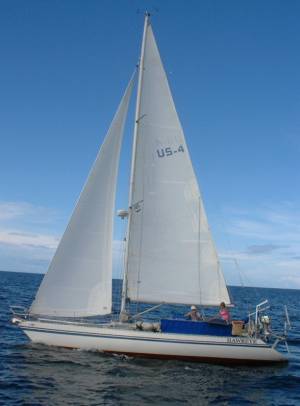
Today, John is trying to get our propane stove to work properly until we can get to a place where we can buy a new one. HAWKEYE is now 23 years old and shows her age when things like the stove have to be replaced. The warm, salt-water environment in the Tropics creates havoc with most materials used on boats. John is putting his mechanical abilities to the test constantly to keep HAWKEYE running by improvising parts, none of which are available in Tonga. I don’t know how people that don’t have this gift manage to keep their boats going in places where there are no experts to hire to fix the problems that arise and there are no parts available. This is probably the biggest reason that people eventually give up the cruising life. John had his 74th birthday October 18 and, thankfully, he continues to enjoy good health. We celebrated with pizza and cake aboard a friend’s trimaran, a boat the size and shape of a small tennis court, which is great for parties!

As the holiday season approaches, we wish you all a glorious time. We don’t miss the hustle and bustle of life in the U.S. but prefer a quiet anchorage with a beautiful sunset. What we do miss is family and friends. So, send us an e-mail and tell us what you are doing!

Linda Keigher & John Kelly, s/v HAWKEYE, Nieafu, Vava’u, Kingdom of Tonga


Thursday, November 30, 2006

HAWKEYE HAPPENINGS, November, 2006

HAWKEYE HAPPENINGS, NOVEMBER 2006

Our stay in American Samoa was a month long; it always takes longer to clear in and out than one expects. We enjoyed our stay there even though the harbor is filled with garbage when it rains and when the wind blows from the east, which it usually does, we got the smell of baking fish. Starkist Tuna has its processing factory here and it provides employment for most of the people living on the island. The island itself is very beautiful but seems to draw bad weather.

We had a wonderful tour of the island one day with some other cruisers and were able to go from one end to the other. It was on “White Sunday” which is a day set aside to honor children. The day consisted of the family dressing all in white and, after attending church, sitting down to a very large meal and then sleeping away most of the afternoon with another meal in the evening. Samoan people are quite large, very friendly and most eager to help in any way. They stop you on the street and ask if they can help in any way.

It was nice to visit a store similar to Costco/Sam’s Club and stock up on some of those luxury items like hamburger, cranberry juice, sliced turkey, bacon, corn on the cob, snacks and ohhhh those baby carrots!

When we first entered the anchorage, we saw a boat we had known in Mexico several years ago, KUMFY. The next day the owner, Mitch Hart, dropped by to say hello and told us he and Rise had been in American Samoa for 5 years. Mitch is an engineer working on a major remodeling of the LBJ hospital and Rise is working for the National Park Service. We visited with them at least twice a week. Mitch begged John to come work for him for a year as he is in desperate need of engineering help to complete the job. He said it would be no problem getting Linda a job at one of the local banks. We said thanks, but no thanks. We are too old to go back to work! We want to keep cruising before we have to give it up.

One day four of us cruisers decided we would try making one of the local dishes. We went to the market and bought taro leaves, onions, and coconut to make the dish. Two of us were busy washing the taro leaves and a small piece of one broke off of the leaf Linda was washing. She put this small piece, about the size of a little fingernail in her mouth and chewed it and swallowed. Immediately, it felt like she had eaten fiberglass. The feeling of little tiny splinters under her tongue and down her throat. Turcan, one of the other cruisers who is from Turkey, took a small bite as she couldn’t believe what Linda was saying and had the same problem. Gert, from Denmark, took a big bite and his wife Carolyn took a small bite. We all had the same reaction. The only thing that would help was a piece of bread and large glasses of water. We then looked on the Internet and learned that you should NEVER eat raw taro leaves, as there are calcium “splinters” which go away when the taro is cooked. We cooked the taro and it was very good but it sure was a painful learning experience.

Another day we took a bus over to the other side of the island to a small village and walked out on a rocky point that was quite beautiful but very warm. We walked through a forested area and found several papaya trees that obviously did not belong to anyone as we could see that the birds were eating the ripened fruit. So we picked a few papayas and headed back to the place where the bus driver said he would pick us up. While waiting for the bus, a fellow that had been on the bus on the way over to the village invited us for lunch at his home. We declined, as we had wanted to get back as we knew another boat we had met in Costa Rica was coming in and was only stopping (they thought) for one night. So we missed an experience that could have been fun but one never knows. At the bus stop we met a woman with a little girl about 2 years old. We talked and told her of the man inviting us to lunch. She said that is very common in Samoa. She was the daughter of the chief of the village and was taking her daughter to the doctor for a checkup. Her daughter’s name is Amazing Grace and she has a twin brother named Mercy. Obviously the church is very important to the people of Samoa!

On the way back, we asked the bus driver to let us off at the top of the mountain pass. We wanted to have a leisurely view from the top down into the bay and surrounding mountains and lush valleys. It was a beautiful sight but we had a very steep hike down the mountain. A few days later, Linda met the woman with the little girl in the post office. She asked how we had gotten back to Pago Pago and we said we walked down the hill. She was quite amazed that we had done that. She also told us that her daughter kept talking about the “palangis” she had met, meaning us. Palangi is used quite frequently to describe a “white” person versus a native in many of the islands.

We had finally received our packages from the U. S. via the good old US post office and waited several days for a good weather window. John checked the GRIB files (computer-generated surface wind and pressure maps), the net weather, and local radio weather. Finally, they all agreed that it was a good time to go the 375 miles to the Vava’u Group of Tonga. We had squalls in the harbor on the way out of Pago Pago, which were quite common, and headed out to the open ocean where we again had squalls with torrential rain (at least, it was warm rain!). We figured once we were away from the island, the weather would improve as all the forecasts had predicted. That was the roughest 375-mile passage we have ever had! As it turned out, a convergence zone (low pressure trough) had moved south over Samoa and followed us all the way down to Tonga. All our friends followed our progress on the radio nets and were happy when we arrived safely, as were we. So much for paying such close attention to the weather forecasts…

The talk of Vava’u was all about weather as everyone was waiting for the “Go” to head to New Zealand. We just wanted to lick our wounds and settled in for a rest. Our “wounds” included the breaking of the genoa’s roller furling line while the sail was reefed way down due to the high winds and seas. Getting the wildly flogging sail down in those conditions was not a piece of cake but we finally managed it and raised the storm jib in its stead. This slowed us down somewhat, and we lost several miles towards our destination by running off downwind. We did not want to be out in those big seas and 25-30 knot winds another night and happily made it in to a wonderfully calm anchorage just before dark. The other “wound” was a problem that we didn’t find out until we were safely in the anchorage. When John went up the mast to replace our flag halyard, he found small cracks in the lower spreaders. This was the same problem that kept HAWKEYE from going to the South Pacific back in ’97.

So, once again our plans have changed. We are not able to go on to New Zealand until we get new spreaders installed. We can order the new spreaders but are not inclined to do so now. If you have been listening to the news of the Kingdom of Tonga, a feudal monarchy in which the King appoints ten of the fourteen cabinet ministers and the hereditary nobility the remainder, you will know that “pro-democracy” rioting recently took place two hundred miles south of here in Nuku’alofa, the capital of the Kingdom. We are in Neiafu, Vava’u Group, in the northern islands, which is the second largest city in Tonga. With 80% of Nuku’alofa’s central business district burned to the ground, there is very little business going on so getting anything sent in (everything has to go through Nuku’alofa), is next to impossible. Linda’s daughter, Trish, sent Linda’s prescriptions the day before the coup started and we are still waiting for that package to arrive. There are some other cruisers going back to the states in a few weeks and will return in a month so we are hoping they will bring back the new spreaders for us.

Other exciting news from the Kingdom of Tonga is that a new island recently arose from the ocean deep, on a sea of floating pumice, about 60 miles west of here. On top of that, Cyclone season is now underway with a new storm, Yani, forming to the west of us. It is 1,500 miles away and is not considered a threat to this area - for now. From the above, you could be forgiven for considering Tonga to be politically, geologically and meteorologically unstable, and hardly a fit place to spend the next several months. In fact, we are enjoying the beautiful island anchorages of the Vava’u group and the friendly people here. We have obtained a cyclone mooring in Neiafu Harbor, a good “hurricane hole”, which consists of two concrete blocks weighing about two tons each plus a lot of heavy chain. John calculates that the mooring should be good for at least 100-knot winds. If and when a cyclone is approaching, we will dash in, secure HAWKEYE on our new mooring, strip the boat of all sails and canvas to minimize windage - and get a hotel room ashore for the duration of the cyclone!

Meanwhile, we will celebrate Thanksgiving today with a turkey dinner attended by 5 different boats. One fellow is from Spain and said he has always wanted to attend an American Thanksgiving as he has only seen it in the movies! Should be fun and interesting. Best wishes to you all for turkey day.

Our hope is to visit New Zealand for about 6 weeks in Feb-Mar via airplane instead of sailing there. Plans are being made already for celebrating Christmas here with an “Umu”, which is a feast where the food is cooked in a pit in the ground lined with hot rocks or coral and covered with banana leaves. It will be a group effort and should be lots of fun.

Just in case you get the impression that cruising is all about lazing around in exotic locations (only partly true), some of our friends have had some really bad experiences. One Canadian couple from Vancouver, whom we met in Ecuador, lost their boat in the pre-dawn darkness on the reef surrounding the island of Niue. They both escaped with minor cuts and bruises by climbing a steep cliff and fighting their way through dense brush to the nearest village. Sadly, their uninsured boat was a total loss. An English couple had the bad luck to require major medical treatment while at sea – not once, but twice! Happily, they arrived in Opua, New Zealand this week and are now getting expert medical attention. A German couple, en route from Samoa to Kiribatis, suffered a broken steering cable in heavy weather with the skipper incapacitated by a kidney stone! Fortunately, the great majority of passages are completed without incident.

Best wishes to all of you for a great holiday season and exciting adventures in the new year. Linda and John s/v HAWKEYE

P.S. We learned at our Thanksgiving dinner that we have to wash the “spinach leaves” we get here in strong bleach water, as there is a snail that leaves a slick on the leaves that causes meningitis. You can believe those leaves are
clean now!


Tuesday, October 31, 2006

HAWKEYE HAPPENINGS, October, 2006

HAWKEYE HAPPENINGS, OCTOBER, 2006

From the lagoon and that wonderful pass at Fakarava Atoll, in the Tuomotu Archipelago, we sailed about 180 miles to Tahiti. It was a good passage and as we arrived at the pass through the reef to Papeete, the wind decided to escalate to 30 knots. It was a nerve-wracking sail through the pass and through the narrow passage with reefs on both sides. Some of the marks into the anchorage were missing so it got quite confusing in the heavy wind, a hefty current, around the airport runway and into the lagoon where we finally were able to get a slip at the dock as we had a long list of things that needed to be done. After a week at the dock at $42 U.S. a night and a few of the projects completed, we headed for the anchorage before we had gone completely broke! Things were slow to happen and we ended up in Papeete for 3 weeks. Papeete is not one of our favorite cities in the world. There is lots of traffic and smog from vehicles and the prices are outrageous. We did, however, manage to spend one day with our friend, Joe Scirica. We had sailed with Joe on his boat, MUSIC, to the Galapagos and then on to Panama the year before. He had single handed his boat from Costa Rica to Tahiti and was shipping his boat back to Mexico and flying back to the U.S. We so enjoyed visiting with him and will miss him as we cruise.

From Papeete, we sailed to Moorea. It is only about a 20-mile trip but we ended up in a squall with high winds. At one point, our wind meter decided to quit when we were blasted with 30-knot winds. During the squall, the rain was so heavy we were not able to see mountainous Moorea even though we were less than 1 mile away. We sailed towards Cook’s Bay and Opunohu Bay using radar and GPS and finally, as we approached the bay, the squall cleared and we could see the pass through the coral reef and the protected bay beyond. It was great to get inside the reef with calm seas and get the anchor down in 10 feet of clear water and relax.

One morning we took a long dinghy ride down to the place where the stingrays hang out and got in the water with them. They come right up and eat out of your hand and rub up against you and there are a LOT of them. Small black tipped reef sharks swam around looking for scraps of food also. Later, we heard of an Aussie swimmer who died from a stingray on the Great Barrier Reef. A sobering thought.

Another day we hiked up to the Belvedere lookout with people from two other boats where we could see down into both Cooks and Opunohu Bays and the surrounding reef. A great hike through the forest to a marae and then up to the viewpoint. Our reward was a wonderful sorbet treat on the way back down.

One evening we went with cruisers from two other boats to the Bali Hai Hotel to watch the dancers perform and sing. It was then time to think about heading to the island of Raiatea where we had scheduled a date to haul the boat as our repaired max prop was being sent back from the states after being balanced and bearings replaced. This seemed to be the problem of the clanking since leaving Ecuador. Seems they had slipped up and not done all the repairs. They will never understand the grief it caused us! But, they did pay for all the shipping charges and repairs they should have done in the beginning…

Anyway, it was an overnight trip to Raiatea and we arrived through the pass into a beautiful anchorage where we stayed waiting out high winds. We took a trip up a river through jungle to beautiful botanical gardens and had a tour and explanation of plants of the area. It was an enjoyable float back down the river and a fun afternoon visiting with cruisers on two other boats. One day we hitchhiked (the accepted way to travel around these islands) to Marae Tapataputea, the most important religious and historical site in French Polynesia.

The fun was over for a while as we headed to Raiatea Carenage Marina and the haulout. We were out of the water four days. John took off the fixed blade propeller and installed the Max Prop. He did a bunch of other maintenance and repairs and Linda cleaned and waxed the hull. Once again, we had a guy come out to work on our refrigeration. It had worked 1-½ weeks since Papeete where we had a guy work on it for 3 weeks. Once back in the water, we headed for the town of Uturoa. The propeller now vibrates at 2600 rpm instead of 2400 rpm (no vibration at all with the fixed blade prop, but that one slows us down too much when we are sailing. I guess we will live with the vibration). We tied to the dock and spent 3 days there. The hike up the hill to the microwave tower was worth the climb as the view was spectacular. We could see the island of Tahaa across the channel and the reef that surrounds both islands and could see Bora Bora 20 miles away. During this time, we had high winds again that blew us on to the dock so we had every fender we have out trying to protect our newly cleaned and polished hull. We also ran numerous lines to different cleats on the dock. It was a rough stay and we were glad to get away early one morning when the winds were down a bit. People from 3 other boats helped us to get away. We had done the same for boats leaving before us.

The sail over to Tahaa was very enjoyable and we relaxed on a mooring in a beautiful, quiet bay and a night of uninterrupted sleep. The next day we were ready to sail the 30 miles to Bora Bora. Again, we had an enjoyable sail and arrived to the pass into the lagoon of Bora Bora just as a freighter was coming out and another coming in. We all three passed at the pinch of the reef. John steered HAWKEYE as close to the side as was safe in order to get out of the way of the two big guys.

We managed to find a mooring right in front of the famous restaurant, Bloody Marys and had a wonderful dinner to celebrate Linda’s birthday, which was back in July. It was worth the wait! We shared our table with another cruising couple on the boat SONGSTER. They are from England and he also worked in the airplane business so there was a lot in common to talk about.

Jackie told us about her having terrible pain in her leg towards the end of their crossing from the Galapagos to Marquesas. Upon arrival in the Marquesas, she was airlifted to Papeete and had surgery to remove a non-malignant tumor. Brian had to sail the boat from the Marquesas to Papeete single-handed and of course was extremely worried about her the whole time. It was quite an experience but they have overcome it and are heading further west.

We had two great snorkels while in Bora Bora with lots of pretty fish and one enormous Moray Eel. The water was crystal clear and warm. The boat looked like it is sitting in air, the water is so clear!

As soon as we had a good weather window, we headed further west. We were going to stop at Palmerston Island in the Cooks but the weather was not good in that direction and so we headed directly to Suvarov (or Suwarrow), which is also one of the northern Cook Islands. This motu is spectacular!! It is a national park about 475 miles from any other land and there is only the caretaker and his family living on this island. John and Veronica and their 4 boys are a joy to meet and visit with. They love having the cruisers visit and want to keep Suvarov unspoiled. Last year they had 114 boats visit and this year 92 have been here. It is just about the end of the season and they will be returning to Rarotonga in October for the hurricane season and will return next April if the government will allow them to. There is a wonderful book written in the 60’s named “An Island to Oneself” by Tom Neale, a New Zealander, who lived on the island alone and wrote of his experiences here. It was a very special read for us.

In the week and ½ we have been here, we have had 3 potlucks and gone on several excursions. We walked the reef from Anchorage Island, which is the main island where John & Veronica live, to Whale Island. It was a wonderful walk mostly in ankle deep water looking at all the beautiful coral and fish-keeping an eye out for sharks and eels that tend to come up and bite on the ankle if given a chance. Another day John took a group of us over to Gull Island to visit the Frigate, Terns, Boobie and Tropic Bird nesting places. We got to see eggs, young, and adult birds of all species. The Tropic Bird is noted for its’ long tail and there were also red footed boobies which we hadn’t seen before. We did a great snorkel on the reef by the birds.

Yesterday, we went with two other boats in our dinghys to Lewin reef inside the lagoon and did a wall snorkel. The most exciting thing seen on this snorkel was the eagle rays. It was so neat to check them out as they fluttered through the water like large butterflies. At one point, a small one went straight up and out of the water and landed with a large splash just a few feet from us. The spotted eagle ray has five barbs at the base of their tail and one does not want to monkey with them!

Today we did another drift snorkel with some other boaters near the pass and went along with the current holding on to the dinghy. At one point, we got behind the reef and had just gotten back into the water to look at some Napoleon fish and a huge shark with big teeth came cruising by. He was 10 to 12 feet in length and quite large around and had spots on him. Not anything like any of the other sharks we were used to seeing on or snorkels here. He was about 20 feet away and we quickly jumped into the dinghy and headed back to the anchorage. Upon checking in our shark book, we concluded it was a Tiger Shark which are quite vicious and have been known to eat just about anything including humans. Well, that was today’s excitement!

We are now waiting for a weather window to head to Pago Pago, American Samoa where we hope to have parts shipped in. HAWKEYE has not seen U.S. waters since 1994 and her crew is looking forward to getting some American products. Our progress has been slow and we are definitely at the end of the pack but we hope to have less crowded anchorages and better weather than those that have gone through so quickly. We are fortunate in that we have no schedule and are sticking to it! John and Linda s/v HAWKEYE
P.S. Oct 6. We have arrived in Pago Pago, American Samoa. We had a good crossing of 475 miles from Suvarov, averaging six knots, and are enjoying being in a US protectorate. We are busy on the Internet ordering parts to be shipped here, as there is no duty. This is a beautiful island and the people are really nice and go out of their way to help us Palangis as we are called. We will probably be here for at least 2 weeks waiting for the different parts to be shipped and then off to Tonga and New Zealand.